
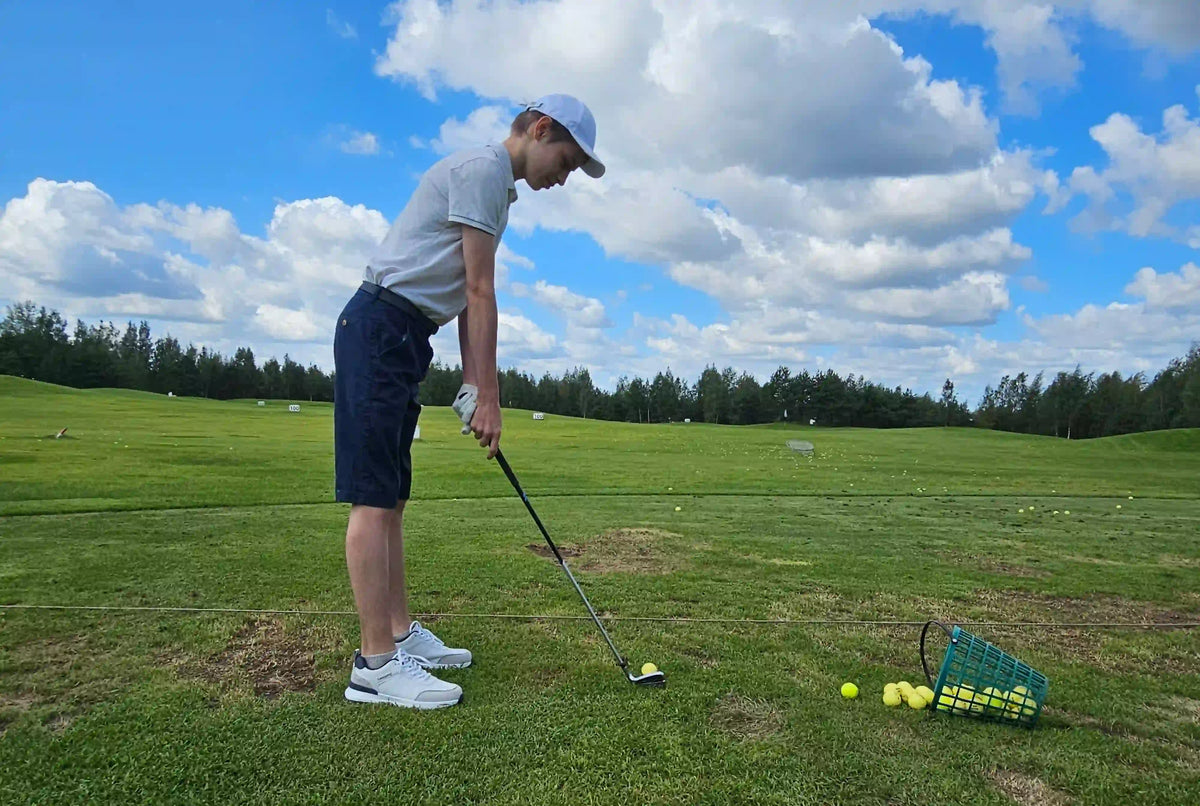
Launch monitor numbers can look a little overwhelming at first.
Carry distance. Total distance. Ball speed. Club speed. Smash factor. Spin rate. Launch angle. Apex. Attack angle.
That is a lot to process.
And if you are not careful, it can start to feel like a scoreboard for your swing. Higher ball speed looks good. A long carry number feels good. A perfect smash factor sounds like proof that you did something right.
Sometimes it is.
But launch monitor data is not useful because it gives you more numbers.
It is useful because it helps you understand what is actually happening to the ball.
That is a big difference.
A golfer who only chases numbers may get frustrated quickly. A golfer who learns what the numbers mean can practice better, choose clubs more honestly, and understand why the ball is flying the way it is.
What do launch monitor numbers actually tell golfers?
Launch monitor numbers help golfers understand distance, strike quality, ball flight, and consistency. Carry distance shows how far the ball flies in the air. Spin rate affects height, stopping power, and stability. Smash factor helps show how efficiently club speed becomes ball speed.
The real value is not one perfect number. It is learning your patterns over time.
Carry Distance Is the Number Most Golfers Should Know First
If there is one number most amateur golfers should understand better, it is carry distance. Not total distance.
Total distance includes bounce and rollout. That can change a lot depending on turf, slope, firmness, and landing angle. Carry distance is cleaner because it tells you how far the ball flew before it hit the ground.
Carry matters when you need to clear water, fly a bunker, or get the ball over a false front. If you are choosing between two clubs, knowing the carry window often matters more than remembering the longest total distance you have ever seen.
A launch monitor helps because it removes some of the guesswork. You may think your 8-iron goes 150 because you have seen it finish there. But if the monitor shows it usually carries 140 to 145, that changes how you should play certain shots.
That may not be the number you wanted to see, but honest carry numbers lead to better club decisions.
Ball Speed and Club Speed Are Not the Same Thing
Club speed is how fast the club is moving. Ball speed is how fast the ball comes off the face. Both matter, but they do not tell the same story.
A golfer can swing fast and still produce poor ball speed if the strike is off-center. Another golfer may swing slower but produce solid ball speed because they hit the center of the face more often. This is where launch monitor data helps: it separates effort from result.
Many amateurs assume that more effort should mean more distance. Sometimes it does. But sometimes swinging harder makes contact worse, spin worse, and distance less predictable.
A good practice session is not just about seeing the highest club speed number. It is about learning what speed you can control. The best number is often the one you can repeat.
Smash Factor Is About Efficiency
Smash factor sounds technical, but the idea is simple. It compares ball speed to club speed. In simple terms, it shows how efficiently energy is transferred at impact.
A higher smash factor usually means the golfer turned club speed into ball speed more efficiently. But that does not mean every golfer should obsess over it. Smash factor is useful when it helps you understand strike quality, not when it becomes another number to chase.
For example, if your club speed is steady but ball speed changes a lot, that may point to inconsistent contact. You may not be missing wildly, but the strike location might be moving around the face. That matters because distance control depends on strike quality.
A shot hit slightly off-center can feel decent and still lose carry. A shot struck cleanly can fly farther than expected. Over time, smash factor can help golfers see whether distance issues are coming from speed, contact, or both.
That is useful practice information. Not as an ego number, but as a clue to what the ball is doing.
Spin Rate Changes Flight and Stopping Power
Spin can be confusing because golfers often talk about it as if more is always good or bad. It depends on the shot.
Too much spin with a driver can cost distance and create ballooning. Too little spin with an iron can make it harder to hold a green. Wedge spin can help control stopping power, but only if the strike, lie, and surface support it.
Spin affects the ball’s trajectory, influencing height, curvature, and stopping behavior after landing. That is why two shots with similar carry numbers can behave differently. One may land soft and stop. Another may come in flatter and release. On the course, that difference can matter as much as distance.
A launch monitor helps golfers connect what they feel to what the ball actually did.
Spin helps explain what the ball is doing in the air. An iron that flies too low and does not hold greens often comes down to spin and launch conditions. A driver that looks fast but falls out of the air may point to too much spin. With wedges, inconsistent spin can reveal changes in strike that are not obvious to the player.
That is why spin is most useful when it is read together with launch, speed, and the club being used.
It is not a tour-only number. It is part of the ball flight.
Launch Angle and Apex Show the Shape of the Shot
Carry distance does not exist by itself. The ball gets there through a flight window. Launch angle and apex help describe that window.
Launch angle shows how high the ball starts. Apex shows how high it reaches. Together, they help explain whether a shot is flying too low, too high, too flat, or too floaty.
This matters because distance and control are both affected by trajectory.
A low iron shot may run out more. A higher iron shot may stop faster. A driver that launches too low may not carry far enough. A wedge that launches too high may lose control in the wind.
Many amateurs judge shots only by where they finish.
A launch monitor helps show how they got there. That can make practice more focused. Instead of saying, "That one felt weird," the golfer can start asking better questions:
- Did it launch too low?
- Did it spin too much?
- Did it carry the right distance?
- Was the strike efficient?
- Did the flight match the shot I wanted?
Those are useful questions.
The Best Data Shows Patterns, Not Just Highlights
The worst way to use launch monitor data is to chase your best shot of the day.
The one long 7-iron. The one perfect driver. The one wedge that spun exactly right.
Those shots feel great, but they are not always the most useful information.
The better question is: What do your normal shots look like?
If your 7-iron carries between 145 and 152 most of the time, that is more useful than knowing you once carried it 158. If your driver spin jumps around wildly, that may matter more than one fast ball speed number. If your wedge carry changes by 12 yards with the same swing feel, that is something worth understanding.
Golf is played with patterns. Not highlight shots.
That is why launch monitor data becomes more valuable over time. It helps golfers build honest baselines: normal carry, common miss, strike tendency, spin window, launch window, and realistic distance range.
Those are the numbers that actually travel to the course.
How Launch Monitor Data Helps On the Course
Launch monitor data does not hit the shot for you. But it can change how you make decisions.
If you know your real carry numbers, you stop choosing clubs based on memory. If you know your normal distance range, you stop expecting one exact number. If you know your spin and flight tendencies, you can better understand why certain shots hold greens and others release.
That is where practice data becomes course management.
A golfer who knows their 8-iron usually carries 142 to 148 can make a smarter decision over water than a golfer who only remembers the time it flew 155. A golfer who knows their driver spin gets high on heel strikes may understand why some drives float and fall short. A golfer who knows their wedges launch too high may practice better distance control instead of just blaming feel.
Good data should make your decisions more honest, not more complicated.

Where a Personal Launch Monitor Fits
A personal launch monitor is useful because it gives golfers feedback they cannot always see with their eyes.
On the range, it can help build club baselines. At home, it can make practice more measurable. During training, it can show whether distance changes are coming from speed, strike, launch, or spin.
That is where tools like the BirdiLens launch monitor fit naturally. The value is not just seeing more numbers. It is learning which numbers explain your ball flight and which patterns matter when you go back to the course.
Carry, spin, and smash factor are not just technical data points. They are clues. They help golfers understand what their swing is producing, what their clubs actually do, and which decisions are realistic when the round begins.
This is also the same idea behind the BirdiLens app and AR golf sunglasses, which bring shot context into on-course decision-making instead of leaving it only in practice data.
FAQ
What is carry distance in golf?
Carry distance is how far the ball travels in the air before it lands. It is different from total distance, which includes bounce and rollout. Carry distance is especially important when golfers need to clear bunkers, water, rough, or the front of a green.
What launch monitor number should amateur golfers focus on first?
Most amateur golfers should start with carry distance because it shows how far the ball actually flies before it lands. Once carry distance is clear, ball speed, spin rate, launch angle, and smash factor can help explain why that distance changes.
What does smash factor mean?
Smash factor compares ball speed to club speed. It gives golfers a sense of how efficiently the strike transfers energy from the club to the ball. It is often useful for understanding strike quality and contact consistency.
Why does spin rate matter in golf?
Spin rate affects ball flight, height, curve, stopping power, and rollout. Too much or too little spin can change distance and control depending on the club and shot type.
Share:
What If You Could See the Shot Before You Hit It
A Better Way to Understand Each Shot in Golf