
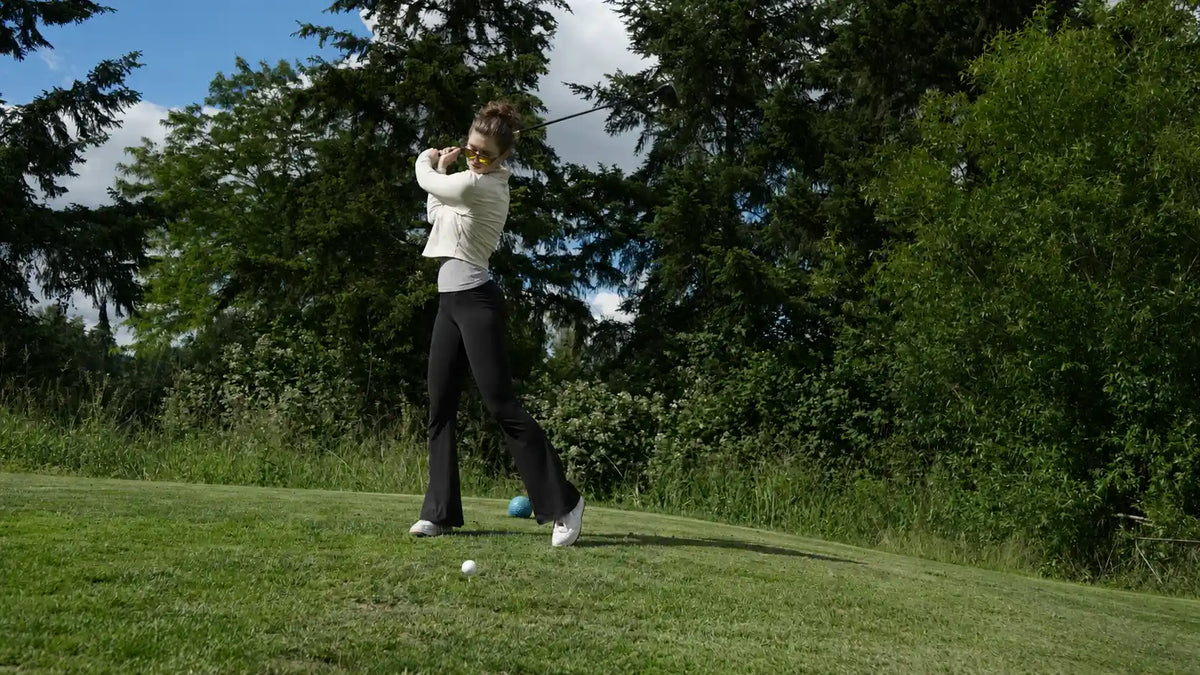
Every golf shot has more going on than the number.
The scorecard says par 4. The GPS says 156. The rangefinder says 153 to the pin. The club in your hand says 8-iron. But the shot itself is asking more questions.
- What does it need to carry?
- Where is the safe side?
- What is the wind doing?
- Is the lie clean?
- Does this club fit your normal swing?
- What happens if you miss slightly?
That is why better golf is not only about measuring more things. Golfers already have more numbers than ever. What many players need now is a better way to connect those numbers to the shot in front of them.
Not after the round.
Not only on the range.
During the moment when the decision actually matters.
What is a better way to understand each shot in golf?
A better way to understand each shot in golf is to connect course context, club data, and real-time shot information into one clearer decision. Golfers need to know not only the yardage, but also carry requirement, wind, slope, target, safe miss, and whether the club in hand fits the shot.
The goal is not more scattered data. It is a clearer shot picture before the swing.
The Course Tells One Part of the Story
The first part of every shot is the course.
Distance matters. Hole shape matters. Hazards matter. Green shape matters. Pin position matters. Wind and elevation matter. A shot does not happen in empty space. It happens on a specific hole, from a specific lie, to a specific target, with specific trouble around it.
A GPS map can help. A rangefinder can help. Course data can help. But the golfer still has to read what the course is asking.
A front bunker changes the carry requirement. A tucked pin changes the target. A firm green changes the landing area. A narrow miss area changes how aggressive the shot should be.
A golfer who only sees the yardage may think the decision is simple. A golfer who sees the course context understands why the same yardage can ask for a different shot.
Your Club Data Tells Another Part
The next piece is the player.
Not the version of your game where everything goes perfectly, but the version you actually bring to the course. Your real carry distances. Your normal miss. Your launch window. Your spin tendencies. Your best strike and your average strike. The difference between the club you want to hit and the club that actually fits the situation. This is where launch monitor data and shot history matter.
If you know your 7-iron usually carries 145 to 150, you make different decisions than a player who only remembers the one time it flew 158. If you know your driver spin jumps on certain misses, you understand why some shots lose distance. If you know your wedge carry range, you stop treating feel shots like guesses.
Good player data does not make golf robotic. It makes decisions more honest. And honest decisions are easier to trust.
The Shot Decision Is Where Everything Comes Together
Both course and club information help. But the golfer still needs to connect them. That connection is the shot decision.
This is the part many tools do not fully solve on their own. A GPS app may show the hole. A rangefinder may measure the pin. A launch monitor may tell you your club data. A tracking system may show patterns after the round.
All useful. But standing over the ball, the golfer still has to decide: What shot am I actually trying to hit?
For example, 156 to the pin might look like a simple 8-iron. But if the front bunker needs 148 yards of carry, the wind is slightly into you, and your normal 8-iron carries 145 to 150, the real decision is not just “Can I hit 156?” It is “Can this club cover the carry and still leave me a safe miss?”
That decision combines the course and the player. It asks whether the club matches the carry. Whether the target matches the risk. Whether the normal miss still leaves a playable next shot. Whether the aggressive line is worth it.
This is the direction useful golf technology should move.
Not just toward more data.
Toward better connection between data and decision.
Practice Data Only Matters If It Helps on the Course
One of the biggest gaps in golf is the gap between the range and the course.
On the range, golfers can measure swing and ball data. They can learn carry numbers, ball speed, spin, launch, apex, and contact patterns. That is valuable.
But on the course, those numbers often get left behind.
The golfer stands over a real shot with wind, slope, trouble, pressure, and an uneven lie. Suddenly, the neat practice data has to become a decision.
A better system should help bridge that gap.
Range data should help build realistic club baselines. Course data should show what the hole is asking. Real-time context should help the golfer understand how today’s shot is playing. The point is not to carry a spreadsheet onto the course.
The point is to make practice information useful when it matters.

Useful Information Should Keep the Golfer in the Moment
The best information is not only accurate. It is usable.
A golfer does not need to feel like they are managing multiple devices before every shot. If the information is split between a phone, a rangefinder, a watch, a launch monitor session, and memory, the player still has to assemble the decision alone.
Sometimes that is fine.
Sometimes it becomes noise.
A better system should reduce that noise. It should make the important pieces easier to access and easier to understand without pulling the golfer away from the shot.
That is why lower-friction information matters. It is why watches, automatic tracking, simplified course maps, and AR-style displays are all part of the broader shift.
The goal is not to make golf passive. It is to help the golfer stay present while making a better decision.
How App, AR, and Launch Monitor Work Together
This is where the BirdiLens approach becomes easier to understand.
The golf app helps with course context: navigation, scoring, real-time data, distance, wind, elevation, and plays-like information. The launch monitor helps with player context: carry, ball speed, club speed, smash factor, spin, launch, and other swing data. The AR golf sunglasses support the on-course moment by bringing useful shot information closer to the golfer’s field of view, so the player does not have to keep switching between the course and a separate screen.
Each piece answers a different question.
- The app helps ask: What is happening on the course?
- The monitor helps ask: What does my swing and club actually produce?
- The AR layer helps ask: How can I understand this shot without losing focus?
The point is not one device trying to do everything. The value is connecting the information golfers already need into one clearer shot decision.

Understanding a Shot Does Not Mean Controlling It
Golf will never be fully controlled.
That is part of the game. You can choose the right club and still miss the strike. You can aim at the smart target and still get a bad bounce. You can read the wind correctly and still watch it shift before the ball lands.
Better information does not remove uncertainty. It reduces unnecessary uncertainty. That is an important difference.
A golfer does not need technology to promise perfect outcomes. They need it to help them avoid avoidable mistakes: the club that never had enough carry, the target that brought the worst miss into play, the shot that ignored wind, the decision based on a best-case distance instead of a normal one.
Understanding every shot does not mean knowing exactly what will happen. It means knowing what you are trying to do and why.
The Future Is Clearer Shot Understanding
Golf technology is already very good at collecting information.
The next step is making that information easier to use during the round.
A better golf system should help the golfer connect the course, the club, the conditions, and the target into one decision. It should make the shot feel clearer without making the round feel busier.
That is where golf technology is heading.
Not away from skill.
Not away from feel.
Not away from the player.
Toward helping golfers understand the shot before they swing.
Because in the end, golf still comes back to the same moment.
You stand over the ball.
You choose the shot.
Then you have to trust it.
FAQ
Why is golf information often hard to use during a round?
Golf information can be hard to use during a round because it is often scattered across different tools, screens, and memories. A golfer may have distance, stats, club data, and course maps, but still need to connect them into one clear shot decision.
How can launch monitor data help on the course?
Launch monitor data helps on the course by giving golfers honest carry distances, speed numbers, spin patterns, and launch tendencies. Those numbers can make club selection more realistic when they are connected to actual course conditions.
What is the benefit of a connected golf system?
A connected golf system helps golfers make decisions with less guesswork. Instead of looking at yardage, club data, course maps, and shot conditions separately, golfers can understand how those pieces fit together before they swing. The benefit is not more data for its own sake, but a clearer shot decision.
How do a golf app, AR glasses, and a launch monitor work together?
A golf app can provide course context, such as distance, hazards, wind, elevation, and plays-like information. A launch monitor can provide player and club data, such as carry distance, ball speed, spin, and launch patterns. AR glasses can help bring useful shot information closer to the golfer’s view, so practice data and course context can support real-time shot decisions.
Share:
What Carry, Spin, and Smash Factor Actually Tell You
How to Break 90 Without Changing Your Swing