
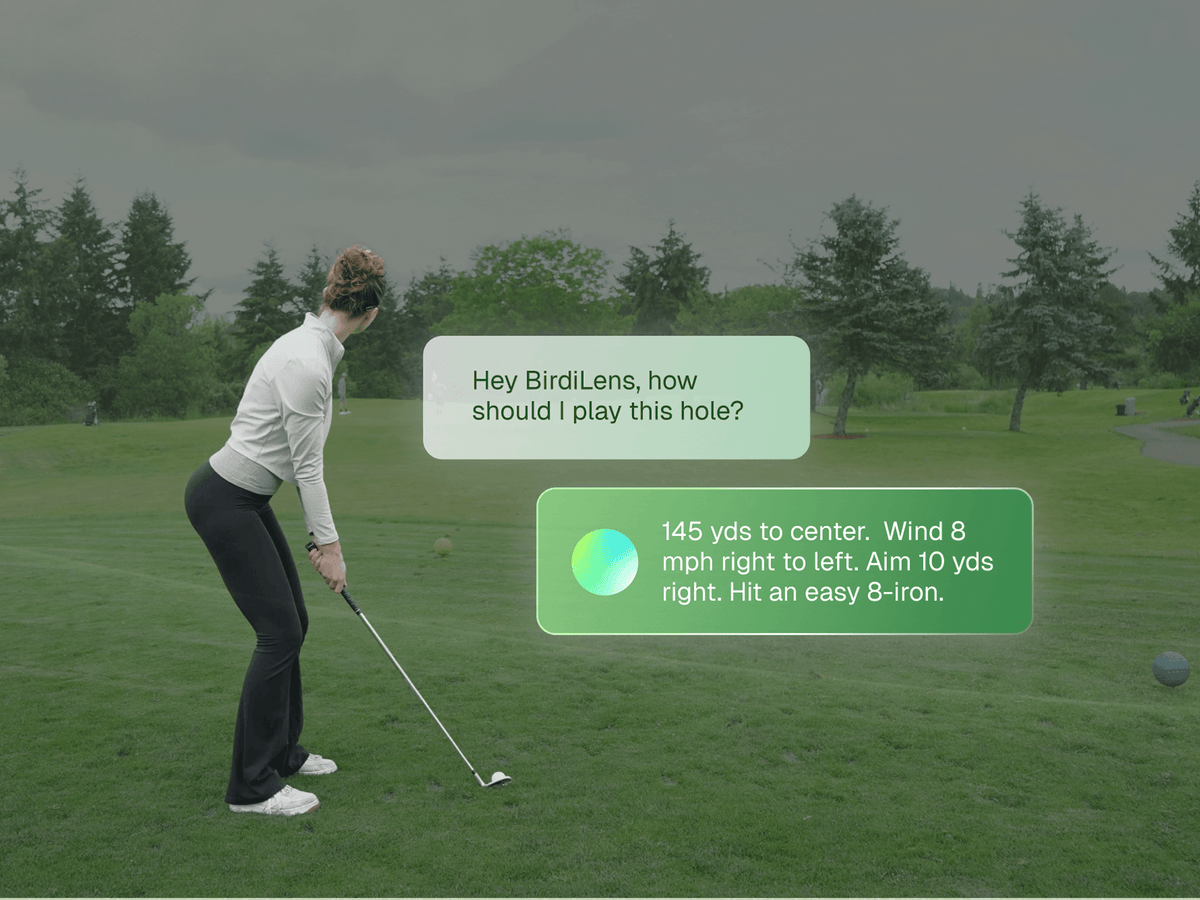
A recent discussion about a proposed AR golf caddie raised a larger question: If technology reads the course, recommends a club, and helps with the putting line, who is actually playing?
The Reddit discussion leaned skeptical. Some golfers rejected the idea of a constant HUD or a system that reads the green for them. Others showed interest in selective information that could be hidden when it was no longer needed.
That concern is fair. Once golf technology moves beyond showing distance and starts interpreting the shot, it takes on part of the decision process.
An AI golf caddie can complete part of the analysis, especially when it recommends a club or putting line. The golfer can still accept, adjust, or reject that recommendation and remains responsible for the target, risk, pace, feel, and execution.
Why the Pushback Is About Control
Most golfers do not object to knowing the distance to the green. Course markers, yardage books, caddies, rangefinders, GPS apps, and watches have made distance information part of the modern game.
The discomfort usually begins when the device appears to decide more of the shot.
A number showing 156 yards to the flag feels like information. A prompt telling the golfer to hit a 7-iron at the left side of the green feels more prescriptive. An AI-generated putting line goes further because reading the break has traditionally been part of the player's own judgment.
AI therefore differs from a sprinkler head or basic rangefinder. It can combine several inputs and recommend an action.
That does not make the system the player, but it does mean a recommendation should be judged differently from a raw yardage. The real question is how much of the golf decision-making process the player wants to delegate.
Control over the display matters too. AR golf glasses place information directly in the golfer's field of view. Even a small overlay can become intrusive if it remains visible after the golfer has finished checking the shot.
Useful AR should let the golfer decide when information appears, what it includes, and when it disappears.
Information, Recommendation, Decision, and Execution Are Different
An AI golf caddie may participate in several parts of a shot, but those parts do not carry the same authority.
| Layer | Example | Who Has Control? |
|---|---|---|
| Information | The flag is 156 yards away, and the front bunker requires 147 yards to carry | The system retrieves or calculates the data |
| Recommendation | A 6-iron fits the adjusted distance, or an AI-generated line fits the scanned green | The system suggests an option |
| Decision | Accept the recommendation, modify it, or choose another plan | The golfer decides |
| Execution | Control setup, pace, feel, contact, and the stroke | The golfer performs the shot |
A recommendation influences the decision, but it is not a command.
The golfer may reject it because the lie is poor, a particular miss has appeared throughout the round, the back of the green is dangerous, or the suggested club does not feel right.
A useful recommendation should also explain its basis. "6-iron" gives the golfer less to evaluate than:
6-iron based on a 162-yard playing distance and your normal 164-to-171-yard carry window.
The second version keeps the golfer involved by showing how the recommendation was produced.
What a Club Suggestion Cannot Decide at 162 Yards
Consider an approach with these numbers:
- The pin is 156 yards away.
- A front bunker requires 147 yards to carry.
- The back edge is 171 yards away.
- Uphill terrain and a headwind make the shot play closer to 162.
- The golfer's 7-iron normally carries 153 to 160.
- The 6-iron normally carries 164 to 171.
A system using historical practice data and current conditions may recommend the 6-iron. The suggestion makes sense because the 7-iron does not reliably cover the adjusted distance.
The final choice still depends on the shot.
If the pin is back-left and a long miss leaves a short-sided downhill chip, the golfer may prefer a 7-iron toward the center and accept finishing below the hole. If several iron shots have already come up short that day, the 6-iron may be the better fit.
The lie, current swing pattern, intended trajectory, and cost of each miss can all change the decision.
The same numbers can support different choices because golfers do not all accept the same risk. That is why a golf pre-shot checklist eventually has to narrow into a carry requirement, target, club, and acceptable miss.
Technology can organize those inputs and suggest an option. The player completes the plan.
AI Putting Makes the Boundary Easier to See
The distinction becomes more obvious on the green.
BirdiLens AI putting uses an app-assisted process. The golfer first uses the Range function in the BirdiLens app to scan and measure the green. The system analyzes the measured data, including slope and break, and generates a recommended putting line.
That line can then appear in the AR glasses, giving the golfer a visual reference without requiring continued phone handling while preparing to putt.
This feature does more than display information. It completes part of the green-reading process.
The golfer still has several decisions to make. A putting line and pace are connected. A firmer putt generally takes less break, while a putt intended to die near the hole may take more. The player must decide whether the suggested line matches the intended pace and current green conditions.
Setup, touch, contact, and starting the ball on the chosen line also remain with the golfer.
AI putting therefore reduces some of the work involved in reading a green. It does not remove the skill required to roll the ball with the right pace and direction.
A Smart HUD Should Know When to Step Back
An eyes-up display can reduce phone checks, but it does not automatically reduce distraction.
A permanent overlay filled with yardages, arrows, wind values, and club data may demand more attention than a quick look at a watch.
BirdiLens is designed around a context-aware HUD. Selected information can appear while the golfer studies the shot, then reduce its presence as the player moves into address.
| Moment | Useful Information | Intended HUD Behavior |
|---|---|---|
| Reading a shot | Pin, green, hazard, plays-like distance, or club suggestion | Display selected information |
| Reviewing a putt | Measured distance, green information, or putting-line guidance | Show the putting reference |
| Moving into address | No further data review | Reduce or hide the HUD |
| Manual control | Any overlay the golfer no longer wants | Allow quick hiding |
The golfer should not receive a complete dashboard by default. Information appears during the decision, and the view becomes quieter when it is time to execute.
This is the practical advantage behind eyes-up golf information. The goal is faster access to the relevant detail, not moving the entire phone interface into the glasses.
Competition Rules Create a Different Boundary
Casual play and tournament play should not be treated as the same use case.
Under Rule 4.3 of the Rules of Golf, golfers are generally allowed to obtain basic distance and directional information. A Committee can still prohibit electronic distance-measuring devices through a Local Rule.
The default permission does not extend to every feature inside the device.
During a stipulated round, a golfer must not use equipment to measure elevation changes or generate a club selection or line of play based on the ball's current location.
- Slope-adjusted or plays-like distance
- A location-based AI club recommendation
- An AI-generated putting line
- Processing current-round performance into new shot advice
Previously prepared club information is different. A golfer may generally consult saved stock distances or other information gathered before the round. The boundary is crossed when the device combines that information with the current ball location to recommend the shot.
Digital green maps may also be subject to size, scale, display, and Local Rule requirements.
The device can contain both permitted and restricted features. What matters is which feature the golfer uses during the round. The guide to using a golf GPS app in a tournament explains these differences in more detail.
Where BirdiLens Fits
BirdiLens AR golf glasses are designed to bring selected course and shot information into an eyes-up view.
The wider system connects several types of information:
- Historical launch monitor sessions establish personal carry ranges and shot patterns.
- The BirdiLens app supplies course maps, pin and hazard information, playing conditions, and app-assisted green measurement.
- AI can combine personal club data with current course information to generate a club suggestion.
- AI putting can use measured green data to generate a recommended line.
- The glasses bring the selected result into view without another full phone check.
A club recommendation does not lock in the club. The golfer can compare it with the lie, current swing, target area, and consequences of the normal miss.
The putting line works in a similar way. It provides a visual reference, while the golfer remains responsible for pace, touch, and execution.
The app and connected data handle retrieval, measurement, and calculation. The glasses handle access. The golfer decides how much of the recommendation to trust.
The Shot Still Belongs to the Player
AI golf technology can reduce the work involved in gathering information. Club recommendations and putting lines can also complete part of the interpretation.
That means AI does take over some tasks that golfers or caddies have traditionally performed. It does not take over every skill involved in playing the shot.
The better test is whether the golfer can understand the recommendation, ignore it, remove it from view, and make a different choice.
Golfers will still select aggressive targets, misjudge pace, reject good advice, and make imperfect swings. They will also hit shots that no algorithm would have predicted.
The technology may shape the plan. The shot still belongs to the player.
Frequently Asked Questions
Does an AI golf caddie choose the club for you?
It can recommend a club based on playing distance, course conditions, and historical carry data. The golfer can accept, adjust, or ignore the suggestion after considering the lie, target, current swing, and acceptable miss.
Do AR golf glasses take skill out of golf?
They can reduce some of the information-gathering and interpretation required before a shot. They do not replace risk management, pace control, feel, or shot execution.
Does AI putting read the green for you?
BirdiLens AI putting uses green measurements from the app to generate a recommended putting line. This completes part of the green-reading process. The golfer still decides whether to trust the line and remains responsible for pace, touch, alignment, and the stroke.
Do AR golf glasses remain visible during the swing?
They do not need to. BirdiLens is designed so the HUD can reduce its presence as the golfer moves into the swing. The display can also be hidden manually.
Are AI club recommendations and putting lines legal in tournaments?
A club recommendation or line of play generated from the ball's current location is not allowed under Rule 4.3 during a stipulated round. Basic distance and directional information may generally be used unless the Committee adopts a Local Rule prohibiting electronic distance-measuring devices.
Share:
Why Range Balls Can Change Your Launch Monitor Numbers