
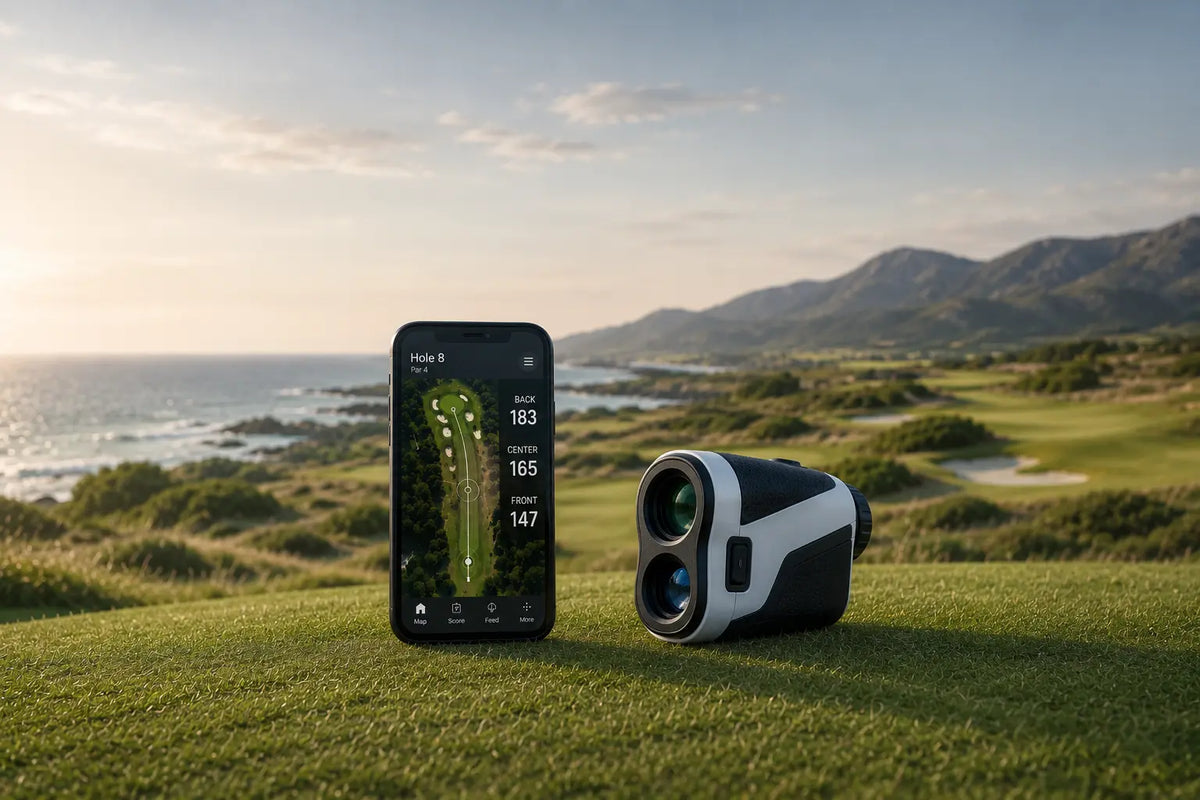
You check your GPS.
150 yards to the flag.
Your playing partner lasers it and gets 147.
Now you're standing over the ball, wondering which number to trust.
And more importantly, does the difference even matter?
Is a Golf GPS or Rangefinder More Accurate?
A laser rangefinder is usually more precise for one visible target, such as the flag. GPS is usually more useful for front, middle, and back green distances, blind shots, hazards, and hole layout. Some devices also provide slope or plays-like estimates, so the better choice depends on the target and the information you need.
| Feature | Golf GPS | Laser Rangefinder |
|---|---|---|
| Measures | Mapped course points | One visible target |
| Best For | Green depth, hazards, blind shots, and hole layout | Exact distance to a flag or visible object |
| Target Precision | Depends on the mapped point and pin location | High when locked onto the correct target |
| Blind Targets | Yes | No |
| Front, Middle, and Back | Usually included | Must be measured separately if visible |
| Slope or Plays-Like Distance | Available in some apps and devices | Available in some slope-enabled models |
| Shot Tracking | Often available | Usually not included |
| Use Speed | Quick glance | Requires aiming and target lock |
In simple terms, a rangefinder is better for a precise distance to something you can see. GPS is better for understanding the space around the target.
Which Should You Choose: GPS, Rangefinder, or Both?
Choose a Rangefinder If You Want One Precise Target
A rangefinder is useful when you mainly want an exact yardage to something visible. That may be the flag, the front edge of a bunker, a tree, a mound, or a landing point you can clearly identify.
It is especially helpful on par 3s and approach shots when the flag is visible and its position matters. You aim, lock onto the target, and get a specific number.
Choose GPS If You Need Course Context
GPS is more useful when the target is not visible or when one number does not tell you enough. It can show the front, middle, and back of the green, along with mapped hazards, landing areas, and the shape of the hole.
That broader view can be more helpful than an exact flag number on an unfamiliar course, a blind approach, or a tee shot where the main question is how much room you have.
Use Both If You Want Context and Precision
GPS can show the structure of the shot, while a rangefinder can confirm the distance to a specific visible target. A golfer might check the front and back of the green with GPS, then laser the flag to see where it sits within that space.
That is why many golfers use multiple distance tools rather than expecting one device to answer every distance question.
How a Golf GPS Actually Works
A golf GPS app or device uses your location and a mapped golf course to calculate the distance to specific points on the hole. These usually include the front, middle, and back of the green, along with hazards and landing areas.
GPS does not necessarily measure the same target as a rangefinder. A laser reading of 147 yards to the flag and a GPS reading of 150 yards to the middle of the green can both be correct.
The number becomes useful only when you know what it refers to. That is the foundation of measuring golf distance accurately.
Where Golf GPS Is Most Helpful
GPS is especially useful for seeing:
- front, middle, and back green distances
- green depth
- hazard locations and carry points
- potential landing areas
- blind targets and unfamiliar hole layouts
Some GPS apps and devices also include slope-adjusted yardages, weather information, or plays-like estimates. Those features can add context, but the golfer still needs to decide which target and landing area make sense for the shot.
What a Rangefinder Does Better
A laser rangefinder measures the line-of-sight distance to the object you aim at. If you successfully lock onto the flag, it can provide a more precise pin distance than a GPS reading to the middle of the green.
That precision is useful, but it depends on aiming at the correct object. A golfer can accidentally laser a tree, mound, or object behind the green. A rangefinder also needs a visible target, so it cannot directly measure a hidden hazard or a blind landing area.
A basic laser reading or competition mode normally provides distance only. Some slope-enabled models can also estimate how elevation changes the effective yardage, although those functions may need to be disabled during competition. A rangefinder still does not show how elevation changes the shot in every situation or how wind changes carry and ball flight.

Why Many Golfers Use Both
GPS and rangefinders are not competing versions of the same tool. They answer different questions.
GPS helps a golfer understand where the green sits, how deep it is, and what hazards or landing areas affect the shot. A rangefinder helps confirm the distance to one visible target. Used together, they can show both the space available and the position of the flag within that space.
Using both does not mean checking every number before every shot. A golfer may use GPS for most of the round and reach for the rangefinder only when the exact pin position matters.
Distance Is Only the Starting Point
GPS and rangefinders can both provide accurate information and still return different numbers because they are often measuring different targets.
The measured distance is also only the starting point. Wind, elevation, lie, required carry, and the safest landing area determine how the shot should actually be played. A golfer first needs to understand what the number refers to, then decide how the conditions change it.
An exact flag distance does not automatically make the flag the right target. A center-of-green GPS number does not automatically account for a front pin, a bunker carry, or the golfer's normal miss. Better decisions come from connecting the measurement to the shot in front of you.
This is also why golfers can still come up short even when the distance looks correct. The number may be accurate, but the selected club, expected carry, or adjustment for the conditions may not be.
From Measuring Distance to Understanding the Shot

BirdiLens is designed to keep mapped course yardage and the surrounding shot information together. The goal is not to replace a rangefinder or any other measurement tool. It is to help golfers understand what the number refers to and how the shot may play under the current conditions.
You still choose the club and target. The difference is that the distance is connected to the context around it, rather than treated as a number on its own.
FAQ
Is a rangefinder more accurate than a golf GPS?
A laser rangefinder is usually more precise for one visible target, such as the flag. GPS provides distances to mapped points, which may include the front, middle, and back of the green rather than the exact pin.
Is GPS or a rangefinder better for beginners?
GPS may be more useful for beginners who want front, middle, and back green distances, hazard locations, and a simple view of the hole. A rangefinder becomes more useful when the golfer wants an exact distance to a visible target.
Can GPS replace a rangefinder?
GPS can replace a rangefinder when mapped course context is more important than an exact pin distance. It cannot always provide the same precision to a specific visible target, especially when the pin location is not mapped.
Do golfers need both GPS and a rangefinder?
No. GPS is enough for golfers who mainly want course context, while a rangefinder may be enough for golfers who mainly want precise distances to visible targets. Using both can be helpful when a golfer wants green depth and hazard information as well as an exact pin distance.
What is the best way to measure distance in golf?
Start by choosing the target. Use a rangefinder for a visible object, GPS for mapped or hidden points, and course markers for a fixed reference. Then adjust the base yardage for wind, elevation, lie, and the required carry.
Share:
Why Your Golf Shot Feels Wrong — Even When You Have the Right Number
How to Stop Guessing Your Distance in Golf