
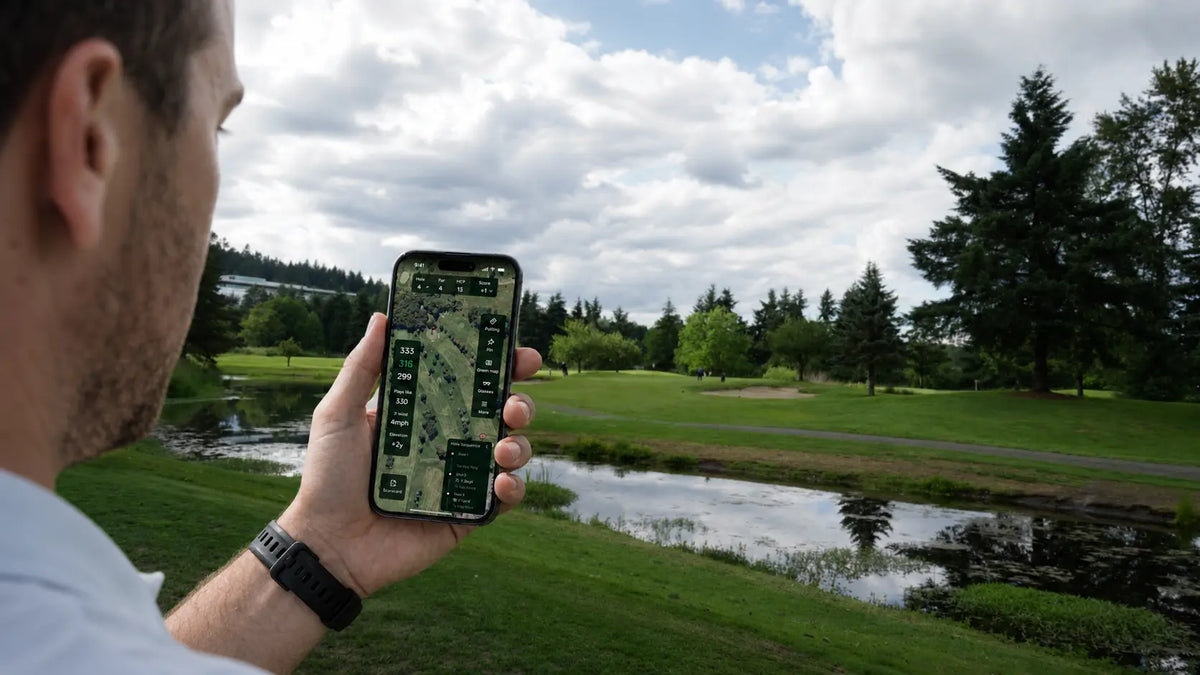
There is a moment in almost every round where the phone becomes annoying.
Not because the app is bad. Not because the yardage is useless. Not because golfers suddenly stop wanting information.
It happens because you are trying to play golf.
You are standing over the ball, looking at the green, feeling the wind, thinking about the club, and trying to build enough confidence to make a swing. Then you look down at your phone. You unlock it, check the number, maybe zoom into the hole map, maybe look at the hazard distance, then look back up and try to rebuild the shot in your head.
Sometimes that works fine.
But sometimes the rhythm is gone.
That is the strange thing about golf apps. They can give you useful information and still feel slightly out of place during the few seconds before a shot.
The problem is not the information.
The problem is where your attention has to go to get it. That is also why golf apps do not always work the way golfers expect during a round.
Why can looking at your phone hurt focus during a round?
Looking at your phone during a round can hurt focus because it pulls your eyes and attention away from the real shot. A golf app may show useful distance, maps, and stats, but the golfer still has to translate that screen information back into the course, target, wind, and club decision.
Better on-course technology should help golfers understand the shot without forcing them to constantly switch between the screen and the course.
Golf Apps Are Useful, But the Timing Is Awkward
Golf apps have made the game easier in real ways.
A phone can show front, middle, and back yardages. It can map the hole, mark hazards, keep score, save shot history, and sometimes adjust for wind, slope, or plays-like distance. Compared with guessing from sprinkler heads or cart-path markers, that is a real upgrade.
The awkward part is not whether the app helps. It is the timing. Checking a phone while walking to the ball is one thing. Checking it while you are already trying to picture the shot is different. That is when the app starts to compete with the pre-shot routine.
You look down, read the number, look up, find the flag again, check the bunker, feel the wind, remember the club, and try to put the whole picture back together. It may not seem like a huge interruption, but golf is a game where small interruptions matter.
The Real Issue Is Switching Attention
A lot of golfers talk about not wanting to “fiddle with the phone” during a round. That phrase is actually pretty accurate.
It is not only about holding a device. It is about switching attention. The golfer has to move from the course to the screen, then from the screen back to the course. The app may show the right information, but the player still has to translate it into a shot. That translation step is where doubt creeps in.
The screen says one thing. Your eyes see another. The number looks fine, but the green looks more elevated than expected. The map shows the bunker, but from the fairway it looks closer. The app says the middle is safe, but the flag is tempting.
Now you are not just choosing a club. You are trying to reconcile two views of the same shot. That is a lot to ask right before swinging.
Good Information Should Stay Close to the Shot
The best on-course information should not feel like a separate task. It should sit close to the shot.
That does not mean every golfer needs the same device. Some players like watches. Some prefer phones. Some want a rangefinder. Some want to keep everything simple. But the direction is clear: the less a tool pulls the golfer away from the shot, the easier it is to use during a real round.
A good golf tool should help answer the important questions quickly:
- How far is it really playing?
- What does the ball need to carry?
- Where is the trouble?
- Where is the safer target?
- Does the club in my hand fit this shot?
Those questions do not need a full dashboard. They need clear context.
Why Hands-Free Golf Information Matters
Hands-free does not matter because it sounds futuristic. It matters because golf is visual.
You choose a target with your eyes. You feel wind on your face. You notice the slope of the ground. You see the bunker, the water, the tree line, the flag, the landing area.
So when the information lives only on a phone screen, the golfer has to do extra work. They have to take numbers from one place and rebuild them into the real course in front of them.
That is why hands-free golf technology is becoming interesting. Not because golfers need more gadgets. Because the best information is often the information that helps while the player is still connected to the target.
A number is useful. But a number that fits into the shot picture is even more useful.
Where AR Starts to Make Sense
AR in golf should not be about filling the view with graphics. That would miss the point.
The useful version of AR is quieter. It helps the golfer keep their eyes closer to the course while still understanding distance, hazards, wind, slope, and target context. The goal is not to make golf look like a video game. It is to make the decision feel less scattered. That matters because GPS distance is not enough on its own if the golfer still has to connect the number to carry, risk, and target.
That is where systems like BirdiLens fit into the conversation. The idea is simple: golfers should not have to keep bouncing between the phone, the number, and the target. If useful information can appear closer to where the golfer is already looking, the shot can feel easier to understand. Learn more at BirdiLens.
The golfer still has to decide.
The golfer still has to swing.
But the information does not have to pull them out of the moment first.

The Better Question Is Not Phone or No Phone
This is not really about whether phones are good or bad. Phones are useful. Golf apps are useful. Many golfers will keep using them.
The better question is: When does the golfer need the information, and what form should it take? For a broader look at why golf is more than raw data, read why golf is not just a numbers game.
Before a round, a phone is great. After a round, a phone is great. Between shots, it can be helpful. But in the moment right before a swing, the best information is the kind that does not break the player’s focus.
That is the future worth paying attention to.
Not more information for its own sake.
Information that fits the round.
Information that helps the golfer stay with the shot.
FAQ
Do golf apps help during a round?
Yes. Golf apps can help with GPS yardage, scoring, course maps, hazard distances, and shot tracking. The issue is not whether they are useful. The issue is whether checking the app interrupts the golfer’s focus before a shot.
Why do golfers dislike using phones on the course?
Many golfers dislike using phones on the course because it can feel slow or distracting. Looking down at a screen, switching between numbers, and then rebuilding the shot visually can interrupt the pre-shot routine.
Why could AR be useful in golf?
AR can be useful in golf when it brings important course information closer to the golfer’s field of view. Instead of forcing the golfer to look away from the course, AR can help distance, hazards, and shot context feel more connected to the real target.
Share:
What Golfers Actually Need During a Round
What If You Could See the Shot Before You Hit It