
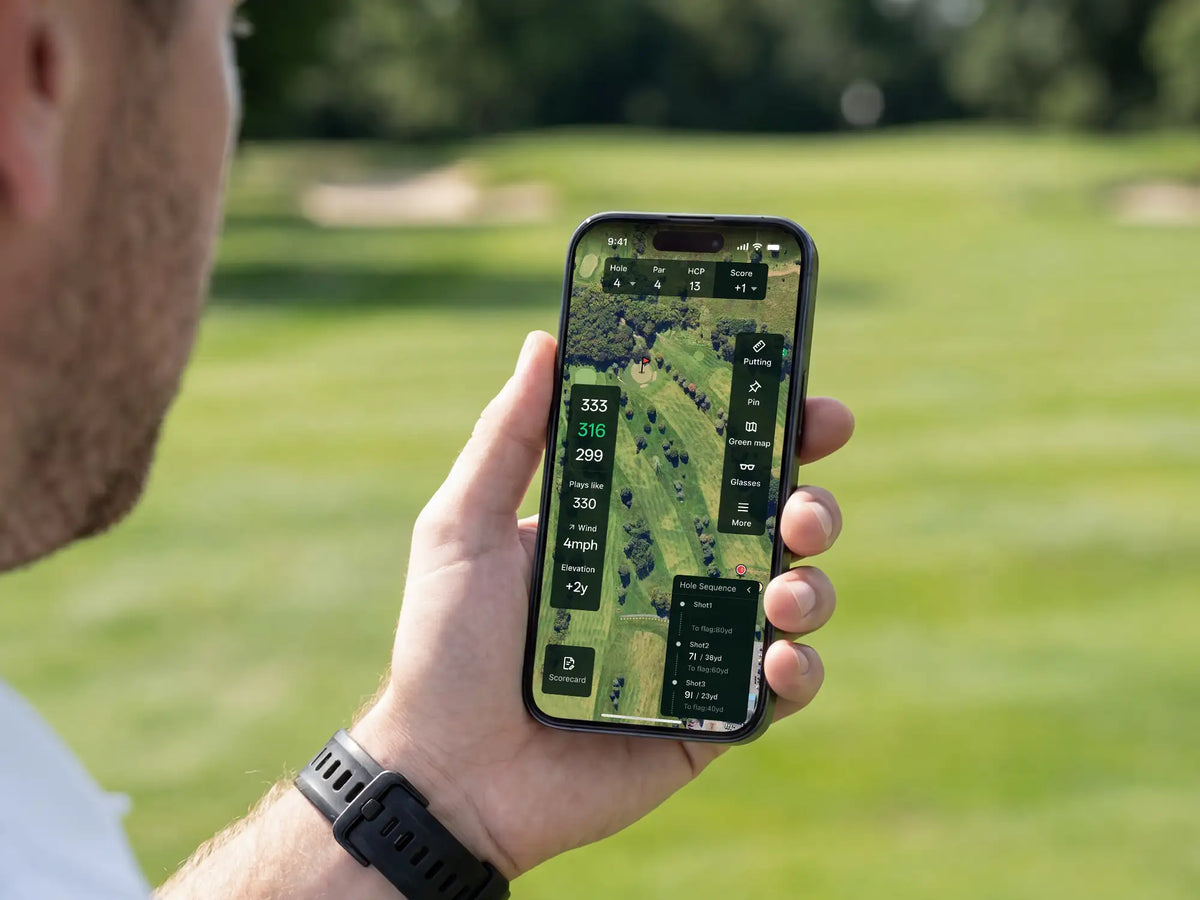
You can have the yardage and still not have a decision.
That happens all the time on the course. The GPS says 156. The flag is visible. The club in your hand makes sense. But there is water short, the wind is into you, and the pin is sitting just far enough left to make your normal miss feel uncomfortable.
Nothing about the shot is impossible. It just is not clear yet.
That is what golfers actually need during a round. Not another number sitting somewhere on a screen. Not a full dashboard of stats while they are standing over the ball. They need a clear picture before they swing: the carry number, the real risk on the shot, and a target they can actually commit to. That is different from simply knowing the flag is 156 yards away.
The game already gives golfers plenty to think about. Distance, wind, slope, lie, pin position, carry, club choice, safe miss, score, pace of play, confidence, doubt. A good tool should not make that mess bigger. It should help the shot feel more playable.
What do golfers actually need during a round?
Golfers need clear, usable information that helps them make a better decision before each shot. That usually means knowing the real distance, the carry requirement, the right club range, the safer target, and the miss they can live with.
More data is not always better during a round. The most useful information is the information that helps the golfer commit without breaking focus.
Golfers Need a Shot Plan, Not More Information
Most golfers do not struggle because they know nothing. They struggle because the information they have does not always turn into a plan. That is why a player can have the right yardage and still feel unsure before the swing.
A player might know it is 150 yards to the flag. They might know their 8-iron can go that far. They might see the front bunker and feel the breeze. But if they have not decided where the ball should land, what miss is acceptable, and whether the flag is actually the right target, the shot is still unfinished.
A shot plan does not need to be complicated. It can be as simple as: "I need to carry the bunker, aim at the middle-right of the green, and take enough club so a normal swing still gets there." That is very different from just saying: "It is 150."
One is a number. The other is a decision. That difference matters because golf is played in motion. You do not get to stand over the ball forever and keep rechecking your thoughts. At some point, the plan has to be clear enough that you can swing.
The Number Has to Connect to Carry, Risk, and Target
Distance is still important. Nobody plays better by guessing blindly. But the number by itself rarely tells the whole story, which is exactly why GPS distance is not enough on its own.
A 150-yard shot to a wide-open green is not the same as 150 yards over water. A 150-yard shot to a center pin is not the same as 150 yards to a pin tucked just behind a bunker. A 150-yard shot downwind may not ask for the same club as 150 yards into a breeze.
The distance may be the same. The shot is not.
Carry Is Often the Real Number
That is why carry matters so much. If there is water short, the important number is not just the distance to the flag. It is the number the ball must fly to clear the trouble. If the front of the green is guarded by a bunker, a club that rolls out to the right total distance may still be the wrong club if it does not carry far enough.
This is where many amateur golfers get fooled. They think they had the right club because the total yardage looked close. But the shot did not ask for total yardage first. It asked for carry.
Carry is one side of the plan. Target is the other. The flag gives you a point, but the target might be somewhere else. If the pin is on the left and your normal miss is left, aiming straight at it may bring the worst outcome into play. The smarter shot may be aimed at the center of the green, even if the flag looks tempting.
Aiming away from the flag isn't playing safe - it's reading the shot correctly.
The Right Club Is Not Always the Club That Matches the Yardage
A lot of golfers think of clubs as fixed numbers. "My 8-iron is 150." That is useful as a starting point, but it is not enough to make every 150-yard decision. Many golfers discover that the same yardage can call for completely different clubs depending on the shot requirements.
The better question is not, "Can this club go 150?" The better question is, "Does this club fit this shot with my normal swing?"
Your Best Shot Is Not Your Normal Shot
Most golfers have a hero shot burned into their memory. Maybe it was the one time they flushed an 8-iron 160 yards on a calm day at the range. But golf on the course does not care about your best shot. It cares about the shot you can produce often enough when the lie is real, the wind is moving, and trouble is actually in play. That is why it helps to build a more realistic distance range for each club, instead of planning around the one perfect strike.
That changes the decision. If the shot is uphill into the wind, your normal 150 club may suddenly feel thin. If the lie is a little heavy, the carry number may need more respect. If long is safe and short is trouble, taking one more club may be the smarter play. If long is dead, the opposite may be true.
A good club decision lives somewhere between data and honesty. The real question is not whether your 7-iron can reach 150 - it is whether your normal swing, from that lie, in those conditions, produces enough carry to clear what is actually in the way. And if your normal miss brings the trouble into play, that should matter before you pull the club.
That is why launch monitor data and shot history can be helpful. Not because they make the decision automatic, but because they make it harder to lie to yourself.
If your 7-iron usually carries 145 to 150, then a forced 155 carry over water is not really a 7-iron decision. It might be possible. But "possible" is not the same as smart.
The Flag Is Not Always the Target
The flag is the easiest thing to look at. It is also one of the easiest things to over-trust.
A tucked flag can make a golfer feel like the shot has to be precise. But many times, the flag is not the right target. It is just the most visible one.
Pick the Target That Protects Your Miss
If the pin is cut close to a bunker, the best target may be the fat side of the green. If water is short, the first job is carrying the water. If the green slopes hard away from the flag, the best shot may land short of the hole and feed down. If the player's common miss is right, a right-side pin may not be worth chasing.
Better players understand this. They are not always trying to hit the prettiest shot. They are trying to leave the next shot playable.
One of the fastest ways amateurs can make better decisions during a round is to ask, "Where can the ball safely finish?" instead of just, "Where is the flag?" Many common distance mistakes amateur golfers make start this way: the number looks right, but the target does not match the real risk.
A good target plan gives the swing room to be normal. It does not demand a perfect strike, perfect start line, and perfect curve just to avoid disaster.
Golf is already hard enough. The target should not make it harder than it needs to be.
Good Information Should Fit the Pre-Shot Routine
The best information during a round is not always the most detailed information. It is the information you can actually use without losing the feel of the shot.
Good Data Should Not Pull You Out of the Shot
That is where some golf tools struggle. The app may have good data. The map may be helpful. The stats may be accurate. But if the golfer has to keep looking down, changing screens, checking one number, then another number, then looking back up and rebuilding the shot in their head, the tool can start to interrupt the routine it is supposed to support. Even useful information can become distracting when it forces the golfer to repeatedly shift attention away from the shot.
That does not mean phone apps are bad. It means timing matters.
A golfer standing over the ball does not need a research project. They need a clear picture. What is the number? What is the carry? Where is the trouble? What club fits? Where is the safer target?
If a tool helps answer those questions quickly, it helps the round. If it adds more steps right before the swing, even good information can feel heavy.
This is why lower-friction golf technology matters. A watch can be easier than a phone. Automatic tracking can be easier than manual entry. A clean course view can be better than a crowded screen. AR-style information can be useful when it keeps the golfer closer to the course instead of pulling attention away from it.
The point is not the device itself. It is whether the information helps the golfer stay with the shot.
Golf Technology Is Moving From Measurement to Decision Support
Golf technology has already become very good at measuring things. It can measure distance. It can map the hole. It can track shots. It can show wind, elevation, plays-like distance, score, club history, and swing data. That is a real improvement from guessing yardage by eye or trying to remember every shot after the round.
But the next step is not just more measurement. It's helping golfers use measurement better.
A GPS number is more useful when it connects to carry and hazards. Club data is more useful when it reflects real conditions. A course map is more useful when it helps identify a safer target. Wind and slope are more useful when they help explain how the shot is actually playing.
Where BirdiLens Fits
This is the kind of moment BirdiLens is built around.
Not the perfect practice-range version of golf, where every number is clean and every lie is flat. The real version of golf, where the player has a yardage, a target, some wind, a normal miss, a bit of doubt, and only a few seconds to turn all of that into a swing.
BirdiLens is designed around the idea that golfers should not have to keep switching between numbers, devices, and the course in front of them during a round. The app is designed to help golfers connect distance, carry, target, and course context into a decision they can trust. The launch monitor helps build more honest club and swing data. The AR glasses point toward a more natural on-course experience, where useful information can appear closer to the golfer's field of view.
A golfer does not only need to know that the pin is 156 yards away. They need to know whether the shot is playing longer, whether the ball must carry trouble, whether the safer target is away from the flag, and whether the club in hand fits a normal swing.
That is the problem BirdiLens is trying to solve. Not making golf automatic. Making the decision easier to see.

What Golfers Should Take Away
During a round, golfers do not need every possible piece of information. They need the few pieces that make the next shot clearer.
They need distance, but not distance by itself. They need club data, but not as a promise. They need a target, but not always the flag. They need technology, but not if it makes them busier than the game already does.
A clear shot does not mean a perfect shot. It means the golfer has a plan before the swing: where the ball should go, what miss is acceptable, and why the club in their hand fits the shot. The tools should not make the round louder. They should make that plan easier to trust.
FAQ
What do golfers actually need during a round?
Golfers need clear information that helps them build a shot plan. That includes distance, carry requirement, wind, slope, club range, landing area, safe miss, and target selection. The most useful information is whatever helps the golfer commit before swinging.
Do golfers need more data to play better?
Not always. More data can help, but only when it changes the decision in front of the golfer. If the data is scattered, distracting, or hard to connect to the shot, it may not lead to better golf. Golfers need usable context, not just more numbers.
Why is target selection important in golf?
Target selection matters because the flag is not always the smartest place to aim. A safer target can give a normal shot pattern more room and help avoid the worst miss. Good target selection often leads to better scores even when the shot does not finish close to the hole.
How does BirdiLens support better golf decisions?
BirdiLens is designed to help golfers connect course information, distance data, performance feedback, and visual context during play. Instead of forcing golfers to keep switching between devices and the course, the BirdiLens approach focuses on making useful information easier to understand before the swing.
Share:
Why Golf Is Not Just a Numbers Game
What If You Didn’t Have to Look Down at Your Phone During a Round