
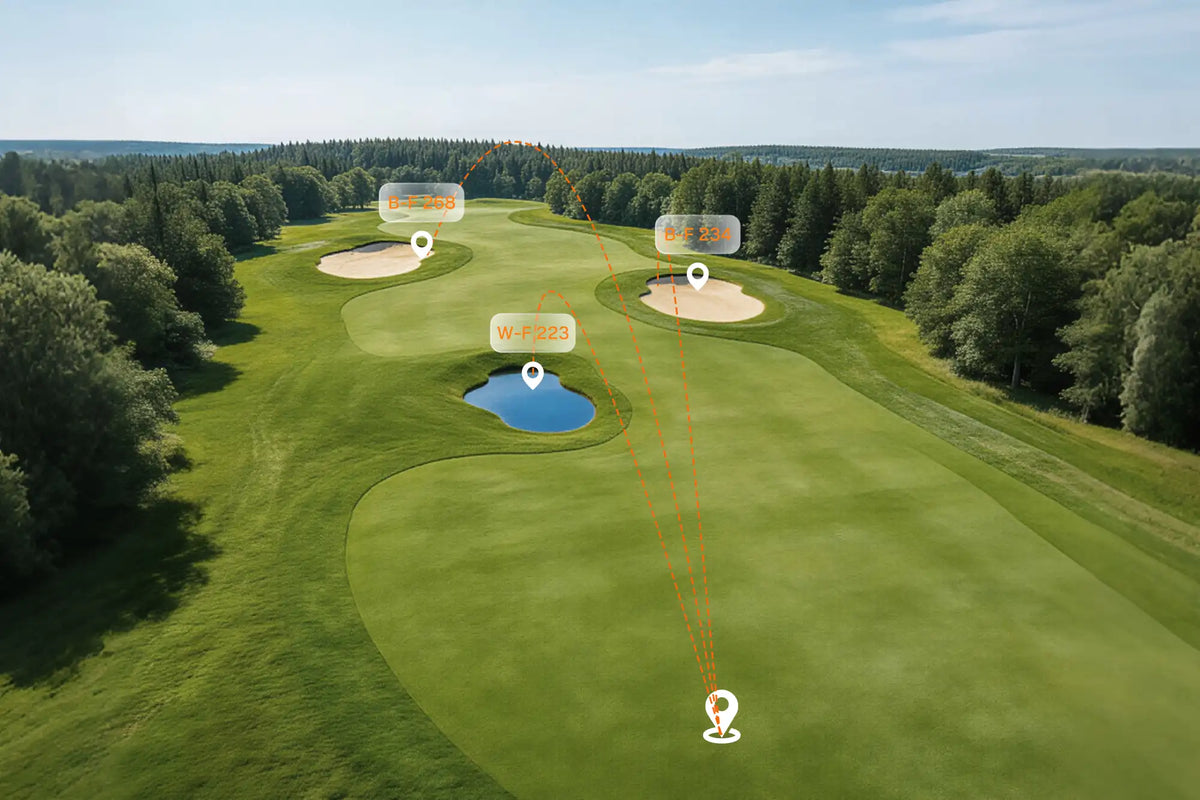
GPS distance is useful.
There is no question about that.
Knowing the front, middle, and back of the green is better than guessing. Seeing hazards on a course map is better than playing blind. For most amateur golfers, a GPS app or golf smartwatch makes the round feel more organized almost immediately.
But there is a point where many golfers run into the same problem.
They know the number, but they still do not fully trust the shot.
The screen says 150 yards. The hole map looks clear. The green is right there. But the wind is slightly into you, the front bunker looks closer than expected, and the pin is sitting in a place where short is no good.
So the question changes.
It is no longer just: “How far is it?”
It becomes: “How is this shot actually going to play?”
That is why GPS distance alone is not enough in golf. It gives you a starting point, but it does not always finish the decision.
Why is GPS distance not enough in golf?
GPS distance is not enough in golf because yardage only tells you how far the target is. It does not always explain how wind, slope, carry distance, landing area, green firmness, pin position, or safe miss should affect the shot.
Modern GPS tools can be very helpful, especially when they include plays-like distance, slope adjustment, course maps, or weather-based information. But even adjusted distance is still only part of the decision. Golfers still need to understand how the ball should fly, where it should land, and what miss they can safely accept.
GPS Distance Solves One Problem, Not the Whole Shot
A golf GPS app does one important job very well: it helps you understand where you are on the course.
That matters. If you are standing in the fairway with no clear marker nearby, a GPS number gives you structure. You can see the distance to the front, middle, and back of the green. You can check hazards. You can understand the hole layout more clearly than you could by eye alone.

But golf shots are not played on a flat map.
A GPS number tells you where the target is. It does not automatically tell you whether the ball needs to fly over a bunker, whether the green will release the ball forward, whether the wind is changing the carry, or whether the safest target is actually away from the flag.
That is the difference between measuring the hole and understanding the shot.
For a golfer trying to choose a club, that difference matters. A good GPS number can keep you from guessing blindly, but the real decision still depends on how that number behaves under the conditions in front of you.
For more on the difference between measurement tools, read golf GPS vs rangefinder.
Why Raw Yardage Can Still Lead to the Wrong Club
Raw yardage feels clean because it gives you something exact.
You see 150 yards and your mind immediately wants to match it with a club. Maybe that is your normal 8-iron. Maybe it is a smooth 7-iron. Maybe it is a number you have hit hundreds of times before.
But the mistake is assuming the number makes the decision for you.
A 150-yard shot to a wide, flat green is not the same as 150 yards to a back pin over a bunker. A 150-yard shot from a clean fairway lie is not the same as 150 yards from light rough. A 150-yard shot downwind may not need the same flight as a 150-yard shot into a breeze.
The GPS number can be correct, and the club choice can still be wrong.
That is one of the most common distance mistakes amateur golfers make. They choose the club that matches the number, not the club that matches the shot.
The better question is not only, "What is the distance?"
It is, "What does this ball need to do before it finishes?"
Plays-Like Distance Helps, But It Still Needs Context
Modern golf GPS tools have become much more advanced. Many premium systems now offer slope-adjusted distance, plays-like calculations, weather-based information, club tracking, or course mapping that goes beyond basic yardage.
That is a real improvement.
A plays-like number can help a golfer understand that a shot may be effectively longer or shorter than the raw distance. An uphill shot may require more club. A downhill shot may require less. Wind, temperature, and elevation can all change how the shot is expected to play.
But even a plays-like number does not answer everything.
A shot may play 160 yards, but that still does not tell you where to land it. It does not tell you whether long is dead. It does not tell you whether the front bunker must be carried. It does not tell you whether a normal miss should be left, right, short, or long.
That is why adjusted distance should be treated as better context, not a complete decision.
It helps narrow the problem. The golfer still has to choose the shot.
Carry, Landing Area, and Safe Miss Matter More Than Golfers Think
One reason GPS distance can feel incomplete is that many golfers think mostly in total distance.
But approach shots are often decided by carry distance.
If there is a bunker, water, rough, or a false front short of the green, the most important question is not where the ball finishes. It is whether the ball can fly far enough to reach the safe landing area.
A shot that totals the right yardage can still be the wrong club if it lands short of where it needs to carry.
Carry Distance Changes the Real Requirement
Imagine the GPS says 150 yards to the pin, but there is a bunker guarding the front of the green. If the ball needs to carry 142 yards to clear the bunker, your club choice has to account for that carry requirement first.
A club that can roll out to 150 yards may not be enough if it only carries 135.
This is where many amateur golfers get fooled. They think they had enough club because the total distance looked close. But the shot needed more carry, not just more total yardage.
For more on this, read how to measure golf distance accurately.
Safe Miss Is Part of the Distance Decision
Distance is not only about reaching the target. It is also about missing in the right place.
If the pin is tucked behind a bunker, the smartest target may be the center of the green. If long leaves a downhill chip, short may be safer. If short brings water into play, taking enough club becomes non-negotiable.
This is why better players often look more conservative than amateurs expect. They are not just aiming at the flag. They are managing the outcome range.
A GPS number can show the distance.
It cannot always tell you which miss is acceptable.
Why GPS Distance Can Make Golfers Feel More Certain Than They Should
There is a quiet danger in a clean number.
It can make a decision feel finished before it actually is.
When a golfer sees 150 yards on a GPS app, the number feels objective. It feels reliable. It feels like the main question has been answered. And sometimes it has. But on many approach shots, the number is only the beginning of the question.
This is where false confidence can show up.
A golfer may trust the number so much that they ignore what their eyes are telling them. The green looks elevated, but they stay with the normal club. The wind feels stronger near the target, but they treat the yardage as neutral. The pin is tucked near trouble, but they aim directly at it because the distance feels familiar.
The problem is not the GPS.
The problem is treating GPS distance as if it contains the whole shot.
For more on why a familiar number can still feel wrong, read why your golf shot feels wrong.
Why Distance Tools Are Moving Toward Decision Support
Golf technology is already moving beyond simple yardage.
That shift makes sense. Golfers do not only want to know how far away the target is. They want to understand what that distance means in the actual situation they are facing.
A rangefinder can help confirm a specific target. A GPS app can show course layout. A launch monitor can help build realistic carry ranges for each club. Shot-tracking systems can reveal patterns over time. Plays-like calculations can adjust for certain conditions.
Each tool helps solve part of the problem.
But the real value comes when those pieces start working together.
Distance becomes more useful when it connects to club history, carry requirement, wind, slope, landing area, and safe miss. That is when the golfer starts moving from raw information toward a clearer shot plan.
This is where decision support becomes different from measurement.
Measurement tells you the number. Decision support helps you understand what to do with it.
From Knowing the Number to Seeing the Shot
The future of golf distance tools is not just more data.
It is better interpretation.
A golfer does not need ten disconnected numbers before every swing. They need a clearer picture of the shot. They need to understand where the ball should fly, where it should land, how it may react, and which club gives them the best outcome range.
That is why visual context matters.
Course maps, shot windows, green information, landing zones, and AR-style guidance all point toward the same idea: golfers make better decisions when they can connect the number to the course in front of them.
This is also where BirdiLens fits naturally into the conversation.
BirdiLens is built around the idea that golfers should not have to keep switching between a device, a number, and the target. By bringing real-time course information closer to the golfer’s field of view, the goal is to make distance, wind, slope, landing area, and green context easier to understand before the swing.
That does not replace the decision.
It makes the decision easier to see.
What GPS Distance Should Actually Be Used For
GPS distance is not the enemy of good golf decisions. It is one of the best starting points a golfer can have.
The key is using it the right way.

Use GPS distance to understand the hole. Use it to identify front, middle, and back yardages. Use it to locate hazards, check the shape of the green, and get a clear starting number.
Then ask the questions the GPS number does not fully answer.
- What does the ball need to carry?
- How is the wind affecting the flight?
- Is the shot uphill or downhill?
- Where should the ball land?
- Where is the safe miss?
- Does my normal club actually fit this situation?
That is when distance becomes useful.
Not as the final answer, but as the first piece of a better decision.
GPS distance changed the way amateur golfers play.
It made the course easier to understand. It reduced blind guessing. It gave golfers access to information that used to be much harder to get during a round.
But golf has never been only about knowing how far away the target is.
A number can help you start the decision. It can give you structure. It can keep you from guessing blindly.
But better golf happens when you understand what that number actually means.
How the shot should fly.
Where it should land.
How it might miss.
What club gives you the best chance to produce the outcome you want.
GPS distance is useful. But the shot still has to be understood.
FAQ
Is GPS distance accurate enough for golf?
Usually, yes. For most amateur golfers, GPS is accurate enough to give a useful starting number, especially for front, middle, and back yardages. The problem is that a good number does not automatically mean a good club choice. If the shot is uphill, into wind, or needs to carry trouble, the GPS number still needs to be interpreted.
Why is a GPS distance different from rangefinder distance?
A golf GPS app usually gives mapped distances to course points, such as the front, middle, and back of the green. A rangefinder measures the laser distance to a specific target, usually the flag. That is why GPS app is helpful for understanding the hole as a whole, while a rangefinder is better when you want a precise number to one target. The difference is that neither one automatically tells you how the shot should actually play.
What does plays-like distance mean in golf?
Plays-like distance is an adjusted yardage that estimates how long or short a shot may actually play after factors like slope, elevation, wind, temperature, or air density are considered.
It can be very helpful, but it is still not the whole decision. A plays-like number may tell you the shot is playing 160 yards, but you still need to know where the ball should land, how much it needs to carry, and where the safe miss is.
Should I use GPS distance or carry distance?
You should use both, but for approach shots, carry distance often matters more than many golfers realize.
GPS distance helps you understand where the target is. Carry distance tells you whether the ball can fly far enough to clear a bunker, water, rough, or a false front. A shot can finish near the right total yardage and still be the wrong club if it does not carry the trouble in front of the green.
Share:
Why Golf Apps Don’t Work the Way You Think During a Round
Why Golf Is Not Just a Numbers Game