
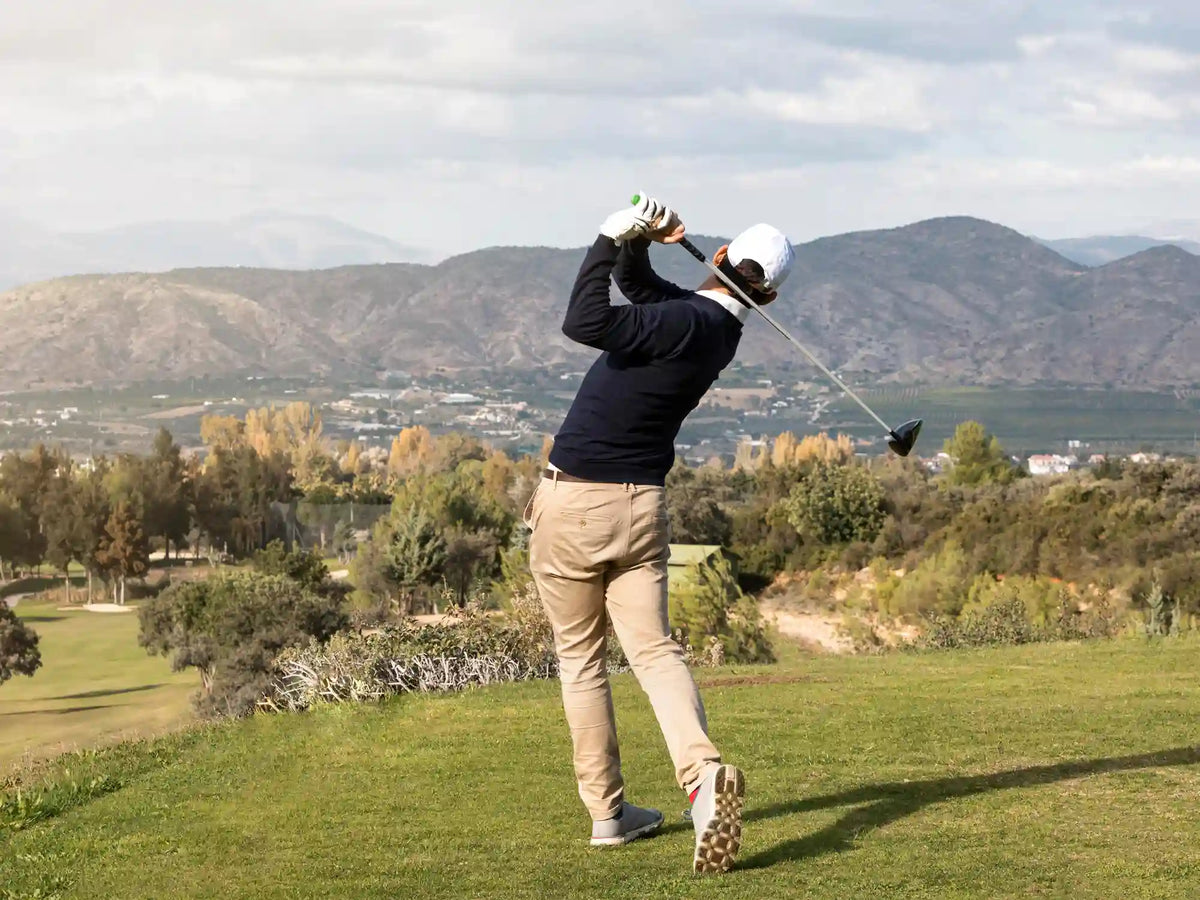
A club that normally covers 160 yards may suddenly fly several yards farther on a mountain course. Drives stay in the air longer, approach shots finish deeper into the green, and a familiar wedge number may no longer produce the expected result.
The club did not change. The air around the ball did.
A golf ball generally travels farther at higher altitude because thinner air creates less aerodynamic drag. The exact change depends on elevation, ball speed, launch, spin, and club choice. Longer shots are usually affected more than short shots, and altitude should not be confused with an uphill or downhill target.
Why Does a Golf Ball Fly Farther at Higher Altitude?
Air density decreases as altitude increases. At higher elevations, fewer air molecules act against the golf ball as it travels.
That changes two important aerodynamic forces:
- Drag, which slows the ball during flight
- Lift, which allows spin to influence trajectory and curve
With less drag, the ball loses speed more slowly. On longer shots, that can increase carry and total distance.
Reduced gravity is not the main reason.
Gravity does become slightly weaker farther from the center of the Earth, but the difference between sea level and a typical mountain golf course is far too small to explain the added distance. The meaningful change comes from lower air density.
Altitude is not the only factor that determines air density. Temperature, humidity, and atmospheric pressure also matter. That is why two rounds at the same course elevation may not produce identical distances.
How Much Farther Does the Ball Fly?
There is no single altitude adjustment that works for every golfer and club.
As a starting estimate, Titleist Golf Ball R&D suggests multiplying elevation in feet by 0.00116 to estimate the percentage increase in distance compared with sea level:
Estimated percentage increase = elevation in feet × 0.00116
That produces these approximate starting points:
| Course Elevation | Starting Distance Estimate |
|---|---|
| 1,000 ft | About 1.2% farther |
| 2,500 ft | About 2.9% farther |
| 5,000 ft | About 5.8% farther |
| 7,500 ft | About 8.7% farther |
At 5,000 feet, a golfer who normally hits a 250-yard drive at sea level might begin with an estimate of approximately 264 to 265 yards:
Sea-level distance: 250 yards
250 × 1.058 = 264.5 yardsThis is an estimate, not a guaranteed carry conversion.
The actual result changes with:
- Ball speed
- Launch angle
- Spin rate and spin axis
- Club choice
- Golfer speed
- Temperature
- Wind
- Ball model
- Ground firmness
Titleist also notes that the percentage increase is generally smaller for slower swing speeds and shorter shots. The full estimate should not be applied mechanically to every club in the bag.
Which Shots Are Affected Most?
Altitude matters most when aerodynamic forces have more time and speed to influence the ball.
Driver and Longer Clubs
Drivers and longer clubs normally produce higher ball speed and longer flight.
The ball travels through the air for more time, so the reduction in drag can produce a more noticeable distance change. Even if two clubs gained the same percentage, the longer shot would gain more yards.
A 5% increase on a 250-yard shot is 12.5 yards. The same percentage on a 70-yard shot would be only 3.5 yards, and short shots often receive less than the full percentage because they travel more slowly.
Driver rollout may also increase if the ball lands with a shallower descent angle. Ground firmness and slope still determine how much of that extra total distance actually appears.
Mid and Long Approach Shots
Altitude can create a meaningful club-selection difference on mid and long approaches.
A sea-level 160-yard club might cover several additional yards at 5,000 feet. Depending on the player and normal club gaps, that could approach a one-club difference.
Carry is not the only concern. Reduced aerodynamic lift can produce a flatter flight and shallower descent. A shot that carries farther may also release more after landing, especially on a firm green.
The golfer therefore needs to check both the required carry and the available stopping area.
Short Wedges and Greenside Shots
Altitude has less effect as shots become shorter and slower.
A greenside pitch spends less time in the air and moves at a lower speed, so aerodynamic forces have less opportunity to change the result. The full driver-based percentage should not be applied to a 30-yard pitch or short bunker shot.
That does not mean every short shot will travel exactly the same distance. Lie, strike, ball choice, trajectory, and landing conditions still matter. Altitude simply becomes a smaller part of the result.
Does the Ball Spin Less at High Altitude?
Altitude does not directly reduce the spin created at impact.
Initial spin comes from the interaction among the club, ball, strike, speed, loft, and delivery. If those impact conditions remain the same, moving to a higher elevation does not automatically create a lower initial spin rate.
What changes is how strongly that spin affects the flight.
Spin creates aerodynamic lift. In thinner air, the same spin rate produces less lift because the air applies less force to the ball. The flight may therefore appear flatter even though the ball did not leave the club with less spin.
Longer shots can also descend at a shallower angle and release more after landing. That extra rollout can make golfers believe the ball had less spin, but the difference may have occurred during flight rather than at impact.
Does Altitude Reduce a Hook or Slice?
A hook or slice curves because the ball's spin axis is tilted. Aerodynamic lift then acts partly sideways, moving the ball left or right.
At higher altitude, thinner air reduces that aerodynamic force.
If ball speed, launch, and spin axis remain the same, the shot will generally curve less than it would at sea level. That can make a hook or slice appear less severe.
The swing pattern has not disappeared. The air simply has less influence on the spinning ball.
The same effect can make intentional shot shaping more difficult. A golfer trying to work the ball around a corner may need to account for less curvature than expected.
Reduced curve also does not guarantee a tighter result. The ball may travel farther, and wind, start direction, and strike can still move it away from the target.
Altitude Is Not the Same as Slope
Altitude and elevation change are often confused because both involve height.
They describe different conditions:
| Factor | What It Describes | Example |
|---|---|---|
| Altitude | The course's height above sea level | Playing in Denver |
| Slope or Elevation Change | The vertical difference between the ball and target | Hitting to an elevated green |
| Temperature | The temperature of the air and ball | Playing on a cold morning |
| Wind | Air moving relative to the ball's flight | Hitting into a headwind |
A course can be 5,000 feet above sea level while a particular approach is downhill. The ball may receive an altitude-related distance increase while the downhill target creates a separate playing-distance adjustment.
An uphill shot on the same course combines the opposite slope effect with the high-altitude air effect.
Do not treat one as a substitute for the other. The difference between the ball and target is explained separately in how slope affects golf distance.
How to Adjust Club Selection at Altitude
Use altitude as one part of the shot calculation, not the entire decision.
Start With Your Normal Carry Baseline
Begin with the carry range you normally produce at your home elevation.
Use a representative range rather than the longest shot you remember. If your 7-iron normally carries 152 to 158 yards, that is a better starting point than calling it a 165-yard club because you once reached that number.
Check the Course Elevation
Confirm the general elevation of the course. If possible, also consider meaningful changes between different parts of a mountain property.
Use the Titleist formula only as an initial estimate. Remember that shorter clubs and slower shots may gain less than the calculated percentage.
Estimate the Longer-Shot Adjustment
Apply the estimate first to drivers and longer shots, where altitude is most likely to create a visible difference.
Do not immediately rewrite every club distance. Treat the calculation as a prediction that still needs to be checked against actual shots.
Add Slope, Wind, and Temperature Separately
After considering altitude, check whether the target is uphill or downhill.
Then review wind and temperature. A cold headwind can reduce or erase part of the expected altitude gain. A warm, calm day may allow the longer flight to appear more clearly.
The full effect of air movement is covered in how wind affects golf shots.
Check the Required Carry and Dangerous Miss
Do not choose a club from the adjusted pin distance alone.
- What must the ball carry?
- How much room is available behind the target?
- Will the ball land at a shallower angle?
- Is the dangerous miss short or long?
- How much rollout can the landing area accept?
A club that easily covers a front bunker may still be the wrong choice if the altitude-adjusted shot can run through the back of the green.
Use the First Few Holes as Calibration
Watch the actual ball flight early in the round.
Compare solid strikes with your expected carry. Pay attention to longer clubs first because altitude should be easier to observe there.
Do not recalibrate from one unusually pure or poor strike. Use several representative shots and note whether the same difference repeats.
Why Your Normal Distance Chart May Not Transfer
A distance chart built near sea level describes the conditions in which it was tested.
It may not transfer directly to a high-altitude course because:
- Each club produces a different ball speed and flight time
- Short shots receive less aerodynamic benefit
- Carry and total distance may not increase equally
- Descent angle can change rollout
- Temperature and wind may reinforce or oppose the altitude effect
- Your swing may change while traveling
Avoid subtracting one club from every approach simply because the course is at altitude.
Keep your normal carry chart and create temporary altitude notes for the trip. If you regularly play at two different elevations, maintain separate observed baselines instead of applying one permanent correction to both.
Golf distances are naturally variable even before altitude is considered. Why Golf Distances Change From Day to Day explains why a normal carry window is more useful than one fixed number.
How BirdiLens Uses Altitude as Context
BirdiLens begins with GPS distance, then can add elevation and other available environmental context to show how the shot may be playing.
That adjusted information becomes more useful when it is compared with the golfer's personal carry baseline. A 165-yard plays-like distance means little unless the golfer knows which club normally covers that carry and how wide its normal distance window is.
Altitude is still only one input. Wind, slope, lie, temperature, green depth, hazards, and the likely landing response can change the final decision.
An adjusted distance is not a prediction of exactly where the ball will finish. BirdiLens can organize the available context and reduce some of the calculation. The golfer still chooses the club, target, trajectory, and acceptable miss.
Frequently Asked Questions
Does a golf ball fly farther in Denver?
Generally, yes. Denver sits at approximately 5,000 feet above sea level, where lower air density reduces aerodynamic drag. Titleist's starting formula estimates roughly a 5.8% distance increase, although the actual result depends on the golfer, club, launch conditions, weather, and shot length.
How much distance do you gain per 1,000 feet?
The Titleist formula suggests approximately 1.16% per 1,000 feet as a starting estimate compared with sea level. It is not a universal conversion. Slower golfers and shorter shots will usually see a smaller percentage increase.
Is altitude the same as hitting downhill?
No. Altitude describes the course's height above sea level and changes air density. A downhill shot describes the vertical difference between the ball and target. A shot can be played at high altitude while also traveling uphill, downhill, or to a level target.
Does altitude reduce a slice?
Thinner air generally reduces how strongly spin axis affects curvature, so an otherwise similar slice may curve less at high altitude. The swing and impact pattern that created the slice still remain.
Share:
How to Use Golf Swing Video With Launch Monitor Data