
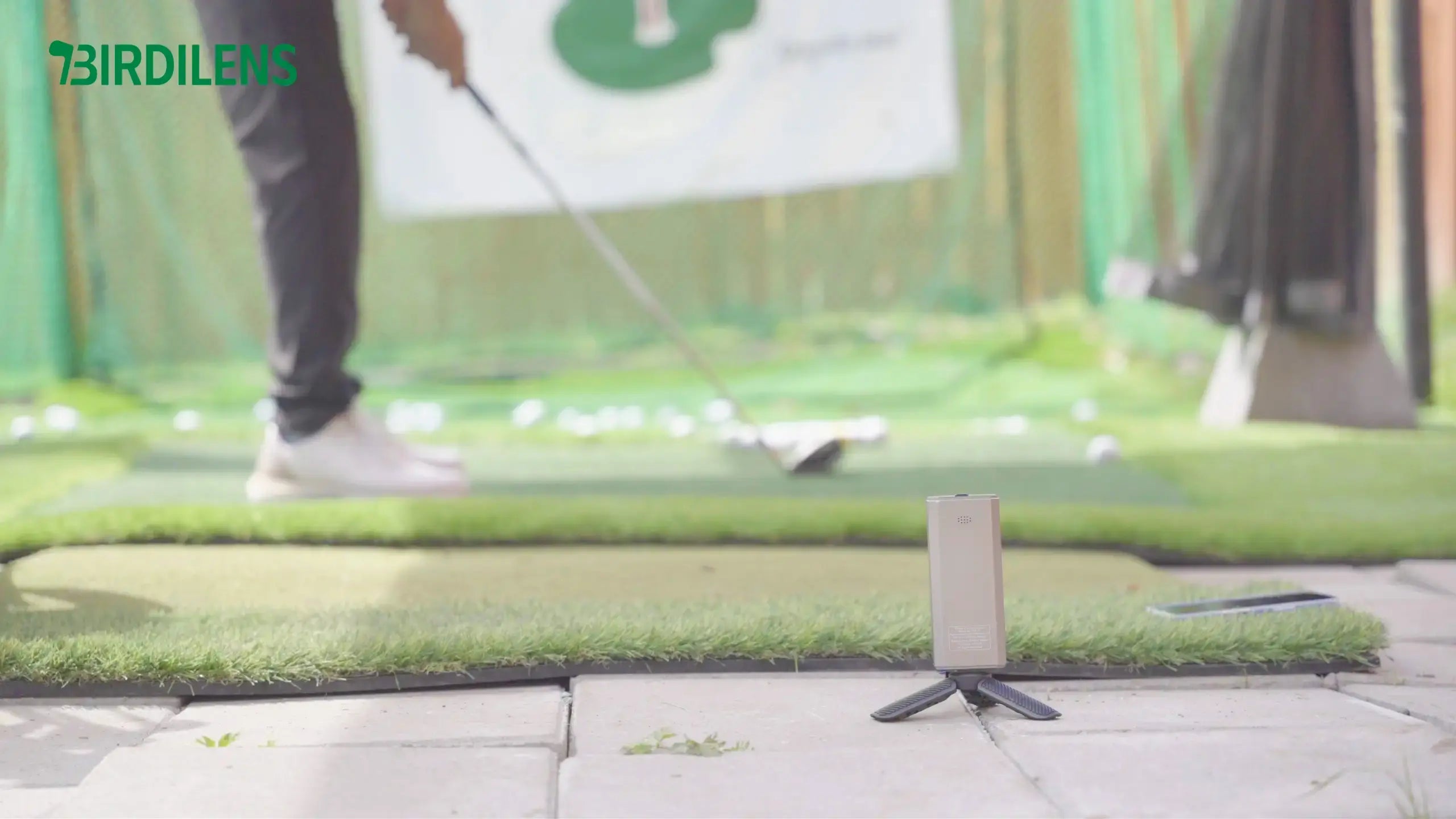
A full wedge may cover one distance, but many scoring shots fall between full-swing yardages. You may need 72 yards over a bunker, 58 yards to a front pin, or a lower 80-yard shot that stays out of the wind.
A wedge distance matrix gives those partial shots a repeatable structure.
Instead of guessing how far a half swing should go, you test the wedges and swing lengths you can actually reproduce. A launch monitor then shows the carry pattern created by each combination.
A wedge distance matrix shows how far each wedge carries with different repeatable swing lengths. To build one, test the same swing lengths with each wedge, record several representative shots, remove only obvious mishits, and use a normal carry number plus a carry window for each combination.
What Is a Wedge Distance Matrix?
A wedge distance matrix is a personal chart that matches different wedges with different swing lengths.
The wedges normally run vertically. Repeatable swing lengths, such as pitch, half, three-quarter, and full, run horizontally. Each cell contains the carry produced by that specific club and swing.
SkyTrak's Wedge Matrix uses this same general structure, allowing golfers to select different clubs, swing types, shot counts, and either carry or total distance.
The purpose is not to create one perfect number for every shot. Golf shots naturally vary. A useful matrix records:
- A representative carry number
- A normal carry window
- A short note about trajectory, contact, or reliability
For example, a golfer may learn that a half 56-degree wedge normally carries 48 to 55 yards, with 52 yards as the representative number. That is more useful than remembering one perfectly struck shot that carried 58.
The matrix fills the distances between full swings. It also reveals which combinations are dependable enough to use on the course.
What You Need Before the Session
Prepare the test before recording the first shot. Changing the ball, environment, or definition of a half swing midway through the session weakens the comparison.
You will need:
- All wedges currently in your bag
- The same ball model throughout the test
- A launch monitor that provides carry distance
- Enough time to warm up
- A stable indoor or calm outdoor environment
- A consistent target and hitting position
- A spreadsheet, notebook, or app for recording results
- Clear names for each swing length
Use the ball you normally play whenever possible. Wedge launch, spin, ball speed, and carry can change with ball construction and condition. Mixed, worn, or limited-flight range balls should not be used to establish permanent course-ball yardages.
If range balls are your only option, use balls from the same batch and treat the results as a provisional practice baseline. The reasons are covered in why range balls can change launch monitor numbers.
Set up and align the launch monitor according to its instructions before testing. Once recording begins, avoid moving the device or changing the hitting location.
Choose Swing Lengths You Can Repeat
A matrix is only useful when its swing labels mean something to the golfer making the swing.
There is no required naming system. The important question is whether you can reproduce a similar motion next week, not whether your "half swing" looks exactly halfway on video.
Feel-Based Swing Lengths
A feel-based system may use labels such as:
- Pitch
- Half
- Three-quarter
- Full
This system is easy to remember, but each label needs a clear personal meaning. "Half" should not mean a short, smooth swing on one shot and a longer, decelerating swing on the next.
Make two or three rehearsal swings before testing a new length. If the motion cannot be repeated without constant adjustment, it is not ready to become a matrix cell.
Clock-Based Swing Lengths
A clock system describes the approximate position of the lead arm or hands during the backswing. A golfer might test 8, 9, and 10 o'clock swings.
The numbers are reference points, not exact measurements. Body shape, wrist set, rotation, and camera angle can make the same swing look different.
Use clock positions only if they create a recognizable feel you can repeat. If "9 o'clock" requires checking video before every shot, a simpler pitch, half, and three-quarter system may work better.
Start with three reliable swing lengths. A smaller matrix you trust is more useful than a large chart filled with motions you cannot reproduce.
How to Test Each Wedge and Swing Combination
Consistency matters more than speed. Plan the session so fatigue does not become another variable.
Warm Up Before Recording
Begin with short pitches and gradually move toward fuller swings. Hit enough shots to establish normal contact and speed before saving data.
Do not include early warm-up shots in the matrix. A 52-yard result created while the golfer is still stiff may not represent the same motion later in the session.
The warm-up should also confirm that the launch monitor is reading shots normally.
Start With One Repeatable Swing
Begin with the swing length that feels easiest to reproduce. For many golfers, that may be a comfortable half or three-quarter swing rather than the shortest pitch.
Use the same swing with each selected wedge before moving to another length. This makes it easier to compare how the club changes the result while the intended motion stays similar.
Another valid method is to complete every swing length with one wedge before changing clubs. Whichever order you select, record it and use the same order when confirming the matrix later.
Hit Multiple Shots
Hit approximately six to ten shots for each club and swing-length combination.
One shot is not a baseline. Three shots can still be heavily influenced by one unusual strike. Six to ten shots usually provide enough information to see whether the results form a recognizable cluster.
Do not select the longest or best-looking shot as the cell value. Keep the normal small misses that are part of your actual pattern.
Remove a shot only when:
- The launch monitor clearly failed to record it correctly
- The ball was topped, shanked, or severely chunked
- An interruption caused you to stop or change the swing
- You accidentally made a different swing length
A slightly thin shot that still resembles a normal on-course result should usually remain. Removing every shot you dislike produces a flattering matrix, not an honest one.
If four of ten shots need to be removed, do not calculate a confident baseline from the other six. Mark the combination as unreliable and test it again.
Also consider the total workload. Four wedges, four swing lengths, and eight shots per combination produce 128 recorded swings. Split the test across two sessions if contact or speed begins to decline.
Record Carry Before Total Distance
Carry distance should be the main value in a wedge matrix.
Total distance includes bounce and rollout. Those can change with turf firmness, landing slope, grass length, moisture, spin, and green speed. A shot that finishes at 70 yards on a soft practice area may finish somewhere else on a firm green.
Carry answers the more transferable question: How far did the ball fly before landing?
That matters when the shot must clear a bunker, water, rough, or a false front.
Launch and spin can be useful secondary notes. They may help explain why two combinations with similar carry behave differently after landing. If these metrics are unfamiliar, Understanding Launch Monitor Data explains how they relate to ball flight.
Repeat With Each Wedge
Continue through the remaining wedges while keeping the ball, target, hitting position, device placement, and testing order as consistent as possible.
Take short breaks between groups. Wedge testing can look physically easy, but repeated partial swings still create mental and physical fatigue.
If the last group suddenly flies shorter, do not immediately treat that as the club's true distance. Rest and confirm the cell later.
Average Carry or Median Carry?
An average adds the retained carry distances and divides the total by the number of shots. It works well when the shots form a tight, balanced group.
The problem is that one extreme result can move the average.
Median carry is the middle result after the shots are ordered from shortest to longest. With an even number of shots, it is the average of the two middle values. Median is less sensitive to one unusually short or long shot.
Consider these eight retained carries:
Both describe the group reasonably well.
If the 74-yard result were replaced by an obvious 52-yard chunk, the average would fall to 65.5 and the median to 67.5. That is why mishit rules should be established before reviewing the final numbers.
For most recreational golfers, use:
- The median as the representative carry
- The central group of shots as the normal carry window
- The complete retained results as a record of overall variation
With eight shots, one practical approach is to use the middle six as the normal window. In the original example, that window would be 66 to 70 yards. The shortest and longest shots remain in the session record, but they do not define the normal window.
If the average and median are close, the results probably form a stable cluster. If they differ substantially, inspect the shots before filling the cell. The combination may be inconsistent, or one result may need to be retested.
A Simple Wedge Matrix Template
A completed matrix might look like this:
| Club | Swing Length | Representative Carry | Normal Carry Window | Notes |
|---|---|---|---|---|
| 56° | Half | 52 yd | 48–55 yd | Reliable |
| 56° | Three-quarter | 68 yd | 64–72 yd | Normal flight |
| 52° | Half | 61 yd | 57–65 yd | Slight overlap |
These numbers are teaching examples only. They are not standard wedge distances or targets golfers should try to match.
Continue adding rows until each tested club and swing length has a representative carry, normal window, and reliability note. Leave an untested or unreliable cell blank instead of estimating it.
How to Find Gaps and Overlaps
The matrix becomes useful when you compare the cells rather than reading them separately.
Look for these patterns:
- Two combinations produce almost the same carry. This is not automatically a problem. One may have a lower flight, wider margin for error, or more reliable contact.
- A normal carry window is unusually wide. The swing may not be repeatable enough to use as a stock option.
- Two reliable windows leave a meaningful gap. Test another repeatable swing length instead of guessing between them.
- A fuller swing adds very little distance. Retest the combination after resting. Contact, launch, spin, or added effort may be preventing a useful distance increase.
- The representative number looks good, but the pattern is scattered. Do not label the cell reliable just because the median matches the distance you wanted.
Overlap gives the golfer choices. A gap identifies a shot that still needs work. An unreliable cell tells you not to build a course decision around that motion yet.
The matrix should describe the shots you own, not every shot you hope to develop.
How Often Should You Update the Matrix?
A wedge matrix is a baseline, not a permanent specification.
Retest when:
- You replace a wedge
- You change your normal golf ball
- Swing speed or technique changes noticeably
- A previously reliable distance stops appearing
- You have not tested for several months
- Indoor and outdoor carry results differ consistently
You do not always need to rebuild the entire matrix. If only one wedge changes, retest that row first. If a swing adjustment affects all partial shots, confirm every relevant combination.
For important yardages, complete one test session and confirm the results on another day. A number that appears in two separate sessions is more useful than a number created by one unusually good practice day.
Taking the Matrix to the Course
Use the matrix to match the required carry with a combination you can repeat.
Then adjust for the actual shot. Wind, temperature, elevation, lie, rough, and the landing area can move the required number or change which trajectory makes sense.
A 68-yard matrix carry does not promise a 68-yard result from wet rough into a headwind. It gives the golfer an honest starting point.
The broader process of connecting personal carry data with hazards and course conditions is covered in How to Use Launch Monitor Data on the Golf Course.

Building a Wedge Matrix With BirdiLens
The BirdiLens Portable Golf Launch Monitor can record carry, ball speed, spin, launch angle, and other shot data during a wedge practice session.
Its connected app allows multiple shots to be reviewed together, making it easier to separate a normal carry cluster from one unusually long or short result. Swing video with data overlays can also help confirm whether shots assigned to the same swing-length label were reasonably similar.
BirdiLens does not need to automatically create every wedge and swing-length combination for the matrix to be useful. The golfer still chooses the wedges, defines the swing lengths, decides which obvious mishits should be excluded, and records the final representative number and carry window.
The monitor captures what each shot produced. The matrix turns those results into a personal distance reference.
Frequently Asked Questions
How many shots do you need for a wedge matrix?
Six to ten recorded shots per club and swing-length combination is a practical starting point. Use more shots or a second session when the results do not form a clear cluster. Split a large matrix across multiple sessions if fatigue begins to affect contact.
Should a wedge matrix use carry or total distance?
Use carry as the primary value because it measures how far the ball flies before landing. Total distance depends more heavily on bounce, rollout, turf firmness, slope, and green conditions. Spin and launch may be added as secondary notes.
Should mishits be removed from a wedge matrix?
Remove only obvious mishits, interrupted swings, and launch monitor misreads. Keep normal small variations that could appear on the course. If many shots need to be removed, mark the combination as unreliable and retest it instead of building a baseline from only the best results.
Share:
What Is Attack Angle in Golf and Why Does It Change by Club?