
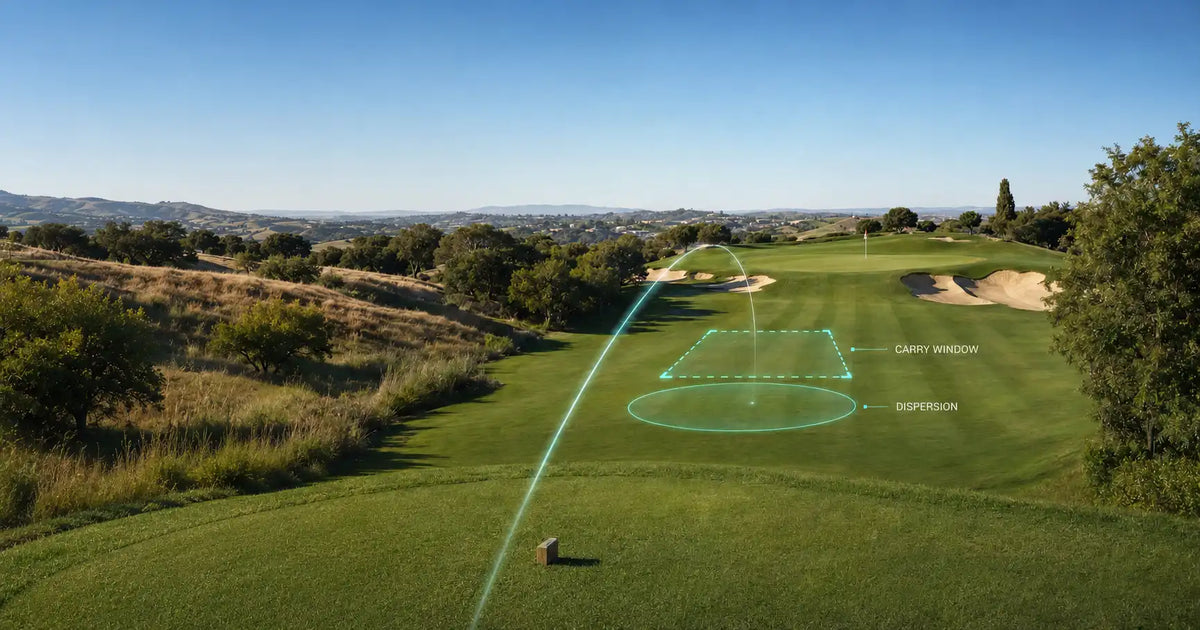
Golfers have more practice data than ever.
A launch monitor can show carry distance, ball speed, launch angle, spin rate, smash factor, apex, and more. A good range session can leave you with plenty of numbers and a few shots that looked exactly the way you wanted.
But numbers do not lower scores by themselves.
Practice data only starts to matter when it helps you make better choices on the course. Which club can you trust? What carry do you actually have? Where does your normal miss go? Can you carry the bunker? Is the flag worth chasing? Should you play to the middle of the green instead?
That is the missing link. Good practice data should not stay on the range. It should become a set of decisions you can use when the shot counts.
How can practice data improve golf decisions?
Practice data improves golf decisions when golfers turn range numbers into practical course rules. Instead of chasing one perfect distance, golfers should know their normal carry windows, common misses, shot dispersion patterns, launch tendencies, and which clubs they can trust under pressure. That information helps with club choice, hazard carry decisions, safer targets, and smarter approach shots.
Practice Data Is Not the Same as Course Strategy
Practice data tells you what happened. Course strategy helps you decide what to do next.
That difference matters. A golfer can know a 7-iron carried 154 yards on one good swing and still make a poor decision on the course. Was 154 the normal carry, or the best one of the day? Did the ball usually miss short? Did it tend to leak right? Would that same shot carry a bunker from a tight lie with wind in the face?
A number is useful only when it has context.
That is why the goal is not to collect more data for the sake of it. The goal is to turn practice data into simple course questions:
- What club gives me enough carry?
- What is my normal miss with this club?
- Where is the bad miss?
- Does this target fit the shot I usually hit?
- Is this a shot I actually trust during a round?
The best players do not collect data just to look at it. They use it to make clearer decisions before the swing.
Start With Carry Windows, Not Perfect Distances
One of the easiest mistakes in golf practice is treating one good shot as your real number.
You hit one 7-iron that carries 155 yards and suddenly that becomes "my 155 club." But if the next five carry 145, 148, 150, 151, and 153, the better answer is not 155. The better answer is a carry window.
What Is a Carry Window?
A carry window, or carry range, is the range your ball normally flies with a club. It is much more useful than one perfect number because golf on the course rarely gives you a perfect version of the shot. You may have wind, slope, pressure, a slightly awkward lie, or a target that brings trouble into play.
If your 7-iron usually carries 145 to 153, that changes the way you look at a 152-yard carry over water. It may be possible. It may even be the right shot sometimes. But it is not the same as saying, "I hit my 7-iron 155."
Do Not Build a Course Plan Around One Best Strike
That is where practice data becomes useful. It helps you separate your best strike from your normal shot.
The same idea applies to wedges, hybrids, fairway woods, and driver. Your average does not tell the whole story. Your range of outcomes often matters more. If you hit a club 170 once but usually carry 158 to 164, it should not be treated as a reliable 170-yard club when trouble is short.
On the course, the question is not "How far can I hit this?" It is "What does this club usually do?"
Play Your Dispersion, Not Your Perfect Shot
Shot dispersion is one of the most useful ideas golfers can take from practice to the course.
Your dispersion pattern is the area where your shots tend to finish with a certain club. It is not one dot. It is a pattern. Some shots finish short, some long, some left, some right. Over time, that pattern tells you much more than your best swing does.
This is where many amateur golfers get into trouble. They plan the hole around the shot they hope to hit, not the pattern they usually produce.
A perfect 8-iron might fly straight at the flag. But if your normal 8-iron pattern finishes a little short and right, a right-side pin over a bunker should change your target. A perfect drive might split the fairway. But if your driver dispersion is wide and your miss is left, a tee shot with out of bounds left should change your line, club, or level of aggression.
Playing your dispersion does not mean expecting bad shots. It means respecting your normal pattern.
That is also why safe miss planning matters. If your pattern tends to lean right, the smart target gives the right miss somewhere to survive. If your approach shots often finish short, a front pin over water may not be worth chasing. If your long irons scatter more than your hybrids, your target should give that club more room.
The goal is not to remove every miss. That is not golf. The goal is to choose targets that make your normal misses less expensive.

Know Your Normal Miss
Your normal miss is one of the most important pieces of practice data you can bring to the course.
Not your worst miss. Not the one terrible shot you hit when the swing completely falls apart. Your normal miss: the pattern that shows up often enough that you should plan for it.
For some golfers, the normal miss is short. For others, it is a fade that leaks right, a pull with longer clubs, or wedges that come out lower than expected. Some players hit driver well enough to keep it in play but struggle to control distance with mid-irons. Others strike irons solidly but have a wide pattern with fairway woods.
Knowing that pattern changes your course decisions.
If your miss is short, you may need to stop taking dead aim at front pins over bunkers. If your miss is right, a right-side flag with water right should probably not be the target. If your longer clubs spread out more than you think, the middle of the green may be a better play than chasing a tucked pin.
This is where practice data connects to real scoring. A miss is not just a swing flaw. It is information. Once you know where the ball usually goes, you can choose targets that fit the shot you actually bring to the course.
Use Launch Monitor Data to Build Club Trust
Launch monitor data is useful when it helps you trust the right club for the right shot.
That does not mean staring at every number after every swing. It means learning the numbers that actually affect decisions: carry baseline, distance window, launch pattern, spin tendency, and how often a club produces the ball flight you expect.
For example, carry distance helps you know whether a club can clear a hazard. Launch and spin can help explain why one club stops on the green while another releases. Ball speed and strike quality can show whether a distance came from a normal swing or an unusually good one.
The point is not to memorize every metric. The point is to build a reliable picture of your clubs.
That is why carry, spin, and smash factor matter most when they help answer course questions. If a hybrid launches high enough and carries reliably, it may become a trusted club on long approaches. If a 5-iron only works when struck perfectly, it may not be the best choice over trouble. If a wedge distance varies too much, that may be a sign to practice partial shots or choose a safer target.
Good data gives you confidence, but it should also make you honest. It shows which clubs you can count on and which shots need more room.
Bring Practice Data Into Real Course Questions
Practice data becomes valuable when it answers the questions you face during a round.
Ask Course Questions, Not Range Questions
A golfer standing over a shot is rarely asking, "What was my ball speed on the range?" The real questions are more practical:
- Can I carry the bunker?
- Is this club enough into the wind?
- Is long better than short here?
- Is my normal miss safe?
- Should I aim at the flag or the middle of the green?
- Do I trust this club from this lie?
- Is this a full swing, a softer club, or a layup?
That is where practice data turns into strategy.
Use the Data to Choose the Safer Play
If your carry window with a 6-iron is 160 to 168, and the bunker starts at 165, you need to think carefully. If your hybrid usually misses left and the left side is dead, the safer choice may not be the aggressive one. If your wedge pattern is short more often than long, a back pin may be less dangerous than a front pin over trouble.
The best use of practice data is not proving what you can do at your best. It is helping you choose what makes sense most often.
That is also the bridge between range work and a complete golf shot decision system. A good decision is not based on one number. It combines player data, course context, risk, target, and the shot you trust.
Where BirdiLens Fits
Practice data and course context usually live in different places.
A launch monitor can tell you what your shots look like in practice. The course tells you what the shot demands right now. Better decisions happen when those two pieces are easier to connect.
That is where BirdiLens fits.
A personal launch monitor can help golfers understand carry distance, club tendencies, ball flight, and normal patterns. The BirdiLens app brings course context into the round: the target, the trouble, the pin position, the carry that matters, and the safer side of the hole. The upcoming BirdiLens AR golf sunglasses build on the same idea by making key shot information easier to see during on-course play.
The goal is not to turn golf into a spreadsheet. It is to help golfers bring the right information into the moment before the swing.
A number from the range matters more when it helps you choose the right shot on the course. A course map matters more when it connects to the shot pattern you actually have. The BirdiLens system is built around that connection: player data plus course context, working together before the decision.

Data Should Change the Shot You Choose
Practice data is not valuable because it looks impressive.
It is valuable when it changes the shot you choose.
If your data shows that your 7-iron usually carries 145 to 153, do not build a plan around the one that flew 158. If your driver dispersion is wide, do not aim as if every tee shot is going to split the fairway. If your normal miss is short and right, do not pretend a tucked front-right pin is harmless.
Good players do not only know their best shot. They know their pattern.
That is how practice data becomes course strategy. It gives you a better sense of what club to trust, what target to choose, what miss to protect, and what shot is actually worth trying.
The point is not to make golf automatic. The point is to make the decision clearer before the swing.
FAQ
How do I actually use my launch monitor numbers on the course?
Start by shifting your focus from your best shots to your normal carry windows. On the course, you are not playing with the single best swing from your range session. You are playing with your real-world baseline. Use your launch monitor numbers to understand how far each club usually carries, how wide the pattern is, what your common miss looks like, and which clubs you can trust under pressure. That way, when you face a tough approach over a hazard, you have a better sense of which club gives you enough margin, even on a slightly imperfect strike.
What exactly is shot dispersion in golf?
Shot dispersion is your ball's natural spray pattern with a certain club. If you hit twenty shots with your 8-iron, they will not all finish in the same spot. They will form a pattern, often something like an oval, with some shots short, long, left, and right. That pattern is your dispersion. Understanding it helps you see that a shot finishing a little left or right is not always a failed swing. It may simply be part of your normal pattern, and you can plan around it.
Why should I play my dispersion instead of chasing the flag?
Because golf is a game of managing misses, and your best shot does not show up on every hole. If a pin is tucked next to a deep bunker and your 8-iron dispersion is 15 yards wide, aiming straight at the flag may bring that bunker into play too often. By aiming the center of your dispersion pattern at a safer part of the green, you give your normal shots more room to finish on the putting surface.
Share:
Why Your Range Game Doesn't Show Up on the Course
Why Golfers Still Use Multiple Distance Tools