
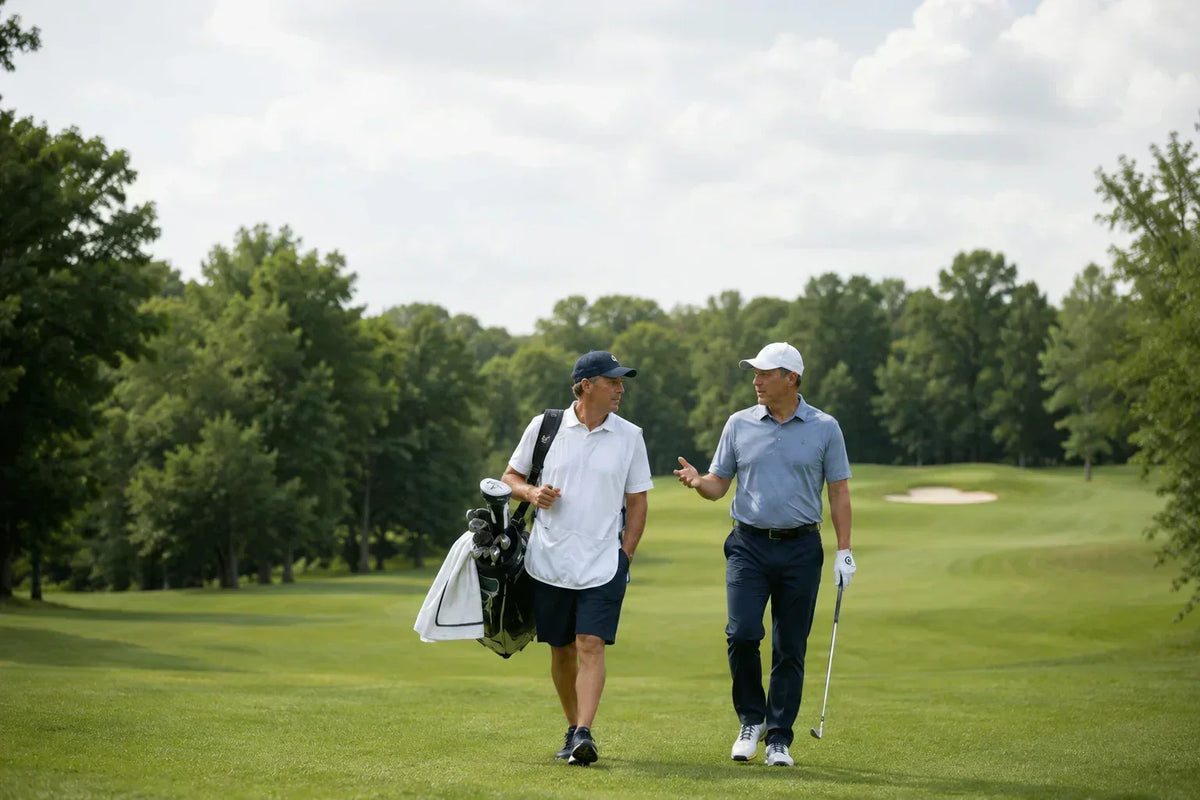
Most people watching professional golf focus on the swing itself — the tempo, the ball flight, the precision. What often goes unnoticed is how much of the shot gets decided before the player ever takes the club back.
That’s usually when the conversation with the caddie happens.
A player steps behind the ball while the caddie checks the yardage book. They discuss the wind, the landing area, the pin position, and sometimes even change clubs entirely before the shot is played. From the outside, it can look like hesitation or overthinking. In reality, it’s one of the most important parts of professional golf.
At the PGA championship level, the difference between a good shot and a bad one often starts long before the swing.
What do PGA Championship caddies actually help players decide?
PGA Championship caddies help players interpret the shot beyond the raw yardage. They assist with club selection, wind evaluation, elevation changes, landing areas, green firmness, risk management, and overall strategy before every shot.
At the professional level, golf decisions are rarely based on a single number alone. Caddies help players understand how the shot is actually going to play in real conditions.

PGA Championship Caddies Do Much More Than Carry Clubs
One of the biggest misconceptions in golf is that caddies are simply there to carry the bag. In reality, professional caddies are deeply involved in decision-making throughout the round, especially during approach shots where small mistakes can become costly very quickly.
Championship caddies constantly help players process information related to distance, wind, slope, landing conditions, pin position, and risk before every important shot. At the highest level, golf becomes less about reacting to a number and more about interpreting the entire situation correctly.
That’s why professional golf is often a shared decision-making process between player and caddie. The player may hit the shot, but the strategy behind the shot is usually built together.
Why Championship Players Rarely “Just Play the Number”
During PGA Championship broadcasts, viewers constantly hear distances mentioned.
“150 to the pin.”
“172 front edge.”
“Playing 165.”
But professional golfers rarely choose a club based purely on raw yardage because the shot itself is never static. A 150-yard approach can play completely differently depending on wind direction, elevation, green firmness, temperature, spin control, or where the safest miss is around the hole.
That’s why Championship players spend so much time discussing shots with their caddies before committing. Players and caddies are constantly evaluating how conditions change the effective shot, not just the measured distance itself. That’s also why many golfers eventually realize there is no such thing as a perfectly correct club for every distance under every condition.
That process is one of the reasons Championship golf often looks surprisingly patient on television. Players aren’t simply choosing clubs. They’re managing outcomes.
The yardage is simply the starting point.
For example, players like Tiger Woods have often spoken about how precise yardage books and pre-shot planning influence club selection long before the swing happens.
What PGA Championship Caddies Look At Before a Shot
Wind and Trajectory
One of the biggest responsibilities of a Championship caddie is helping evaluate how wind affects ball flight . Not just whether the wind is helping or hurting, but how it changes trajectory, spin, carry distance, and landing behavior.
Sometimes the correct decision is taking more club and hitting a lower flighted shot into the wind. Other times the player may need additional height to stop the ball on a firm green. Those decisions depend on how the shot is expected to fly, not simply what the distance says on paper.
That’s why Championship players often talk about how a shot is “playing,” rather than only discussing the actual yardage.

Elevation and Effective Yardage
Championship caddies also constantly adjust for elevation changes . A shot that technically measures 150 yards may effectively play much longer uphill or significantly shorter downhill depending on the slope and conditions.
These adjustments become especially important during major championships where greens are firmer, landing areas are smaller, and controlling carry distance becomes critical.
This is one of the reasons professional golfers sometimes choose clubs that surprise amateur viewers. They are reacting to effective yardage, not just measured distance.
Landing Areas and Green Conditions
Professional golfers rarely focus only on where the ball lands. They also think carefully about how the ball will react once it reaches the green.
Championship caddies help evaluate green firmness, rollout, slope around the pin, and which landing areas provide the safest margin for error. A tucked pin behind a bunker may completely change the target line even if the distance remains identical.
That’s why professional golf often looks more conservative than many amateur players expect. The smartest target is not always the flag itself.
Miss Position and Risk Management
One of the most underrated parts of professional golf is understanding where mistakes can safely happen. Championship caddies constantly evaluate which misses are manageable and which ones create extremely difficult recovery shots.
Sometimes the smartest decision is not attacking the pin directly. It’s choosing the side of the green that removes the possibility of a short-sided chip, a deep bunker recovery, or a downhill putt with almost no margin for error.
Professional golf is often less about perfect execution and more about intelligent misses.
That’s also why many Championship broadcasts show players and caddies discussing where the safest miss is before attacking a pin. Players like Scottie Scheffler are often praised for disciplined target selection and avoiding high-risk misses, even when they appear to be playing conservatively.
Why Amateur Golfers Often Feel More Uncertain
Most amateur golfers already have access to accurate distance information through GPS apps or rangefinders, but many players still struggle with uncertainty over the ball. A player may know the exact yardage and still feel uncomfortable because they’re mentally trying to combine wind, slope, visuals, landing conditions, trajectory, and club selection within just a few seconds before the shot. It’s the challenge of interpreting what that data actually means in real playing conditions.
Without a clear picture of how the shot is actually going to play, many golfers end up stuck between clubs or second-guessing their decisions before the swing even begins.
That uncertainty is something professional golfers experience too. The difference is that Championship players and caddies are better at organizing uncertainty into a decision they trust.
The Hidden Skill Behind Professional Golf
People often assume Championship players succeed primarily because of mechanics and ball striking. While that’s certainly true, one of the biggest differences at the professional level is decision-making under pressure.
Great players know how to evaluate conditions, understand effective yardage, choose safe targets, and fully commit once the decision is made. That process is happening constantly throughout every round, even when viewers barely notice it.
This is also where great caddies become incredibly valuable. They help simplify complex situations into a shot the player can commit to confidently. Not because uncertainty disappears completely, but because the player understands the situation more clearly before swinging.
And in golf, commitment often matters just as much as mechanics.
Why Golf Technology Is Moving Toward Decision Support
Modern golf technology has become extremely good at measuring distance, but professional golf continues to show why distance alone is rarely enough.
The real challenge isn’t collecting more numbers. It’s understanding how the shot is actually going to play in real conditions. That’s why golf technology is increasingly moving toward decision support systems that combine distance, wind, slope, course context, and shot visualization into a more complete on-course experience.
Not to replace human judgment, but to support it in the same way a Championship caddie supports a player during a round.
Tools like BirdiLens are built around that idea — helping golfers spend less time interpreting information and more time committing to the shot in front of them.

The next time you watch a PGA Championship event, pay attention to everything that happens before the swing.
The conversations with the caddie.
The club changes.
The discussion about wind or landing areas.
The extra look toward the flag before committing.
That process isn’t slowing the game down.
It is the game.
Because great golf has never really been about finding one perfect number. It’s about understanding the shot well enough to commit to it.
Share:
How to Stop Guessing Your Distance in Golf
Common Golf Distance Mistakes Amateur Golfers Make